0%

In 2026, Narrow Aisle Pallet Racking will remain important for warehouses facing high land costs and growing SKU counts. Aisles may shrink to roughly 1.8–2.7 meters, depending on the truck and load design. That change can create more storage positions, but it also demands tighter operating discipline.

The MHI 2024 Annual Industry Report states that 55% of supply chain leaders planned to increase technology investment over the following two years. Labor shortages and faster fulfillment expectations support this direction. Yet, automation alone does not solve poor rack planning. A damaged upright, uneven slab, or incorrectly rated beam can undermine the entire system. Small details matter.

This guide compares single-deep selective, double-deep, and very narrow aisle configurations. It also considers reach trucks, turret trucks, pallet dimensions, load rotation, and fire-protection coordination. In practical warehouse projects, the “best” rack type often depends on throughput rather than maximum density. That point is easy to overlook. High-density storage can reduce accessibility, increase travel complexity, and create costly replenishment delays.

Technical decisions should be checked against recognized guidance, including RMI MH16.1 and EN 15635 where applicable. Local building, fire, and workplace requirements must also be confirmed by qualified professionals. Industry reports provide useful direction, not a complete engineering design. This article offers a practical 2026 framework, while acknowledging one uncomfortable truth: a rack layout that looks efficient on paper may perform poorly beside a real loading dock.
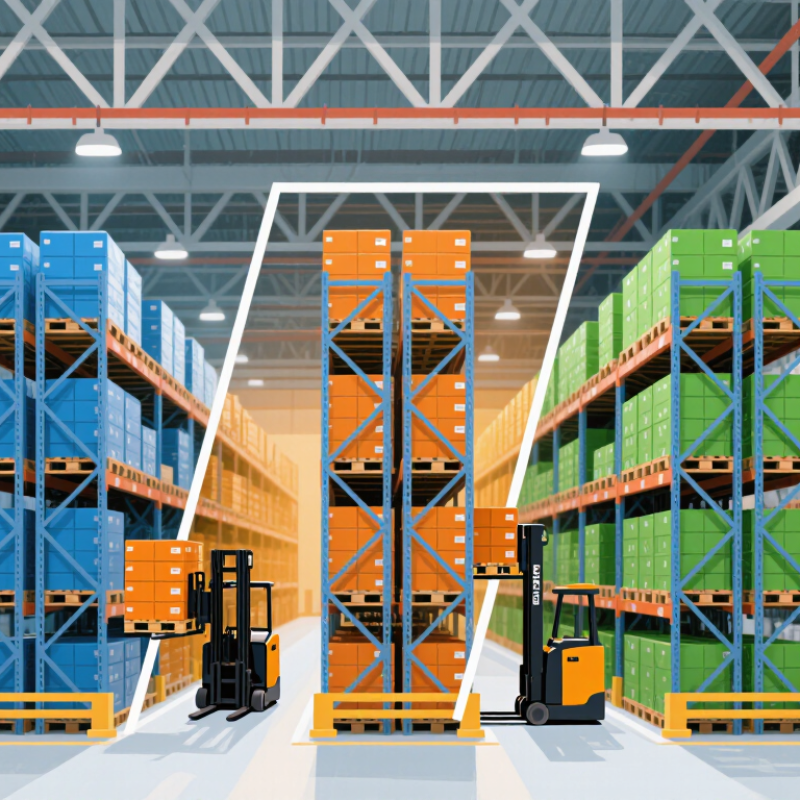
2026 Best Narrow Aisle Pallet Racking Types?

What Defines Narrow Aisle Pallet Racking in 2026?

In 2026, narrow aisle pallet racking is defined less by a fixed width than by coordinated operating conditions. Most layouts reduce working aisles to roughly 1.8–2.5 metres, depending on the truck, pallet size, and turning method. The rack must support higher storage density without blocking safe retrieval. That balance is the real definition. Not just a smaller gap.

Common configurations include narrow-aisle selective racks, double-deep racks, and very-narrow-aisle systems served by guided turret trucks. Selective designs provide direct access to each pallet, while double-deep storage increases density but reduces immediate choice. Very-narrow-aisle layouts may use rail guidance, wire guidance, or navigation controls. In 2026, sensors, warehouse software, and collision alerts increasingly shape the system. They should assist trained operators, not replace inspection or judgment. The details matter.

Reliable design begins with measured details: load weight, pallet quality, floor flatness, mast height, fire clearances, and daily travel patterns. A qualified engineer should verify beam capacity, anchoring, impact protection, and local requirements before installation. One practical warning is often missed: an efficient aisle can become slow when pallets arrive damaged or mixed in size. Narrower is not automatically better. Teams should test turning space with the actual truck and load. Even experienced planners can overestimate usable capacity. That uncertainty deserves a trial layout, not optimistic drawings.

How to Compare Major Narrow Aisle Racking Types

2026 Best Narrow Aisle Pallet Racking Types?

Choosing narrow aisle pallet racking starts with comparing operating conditions, not advertised storage density. Selective narrow aisle systems suit warehouses needing direct access to many pallets. Reach-truck layouts usually balance capacity, flexibility, and moderate aisle reduction. Very narrow aisle systems use specialized guidance equipment and can create more locations, but they demand accurate floor levels and disciplined driving. Turret-based equipment can work at greater heights, although purchase, maintenance, and operator training costs require careful review. No option wins everywhere.

Compare each system by aisle width, pallet dimensions, ceiling height, floor tolerance, and daily pallet movements. Measure real equipment turning paths, not only rack drawings. A dense layout may look efficient, yet slow replenishment if travel distances increase. Consider selectivity too. If every pallet needs frequent access, double-deep storage may create inconvenient handling steps. If inventory moves in predictable batches, that compromise could be reasonable. A perfect spreadsheet can still mislead.

Tips: Request a site survey from a qualified racking professional. Record current aisle congestion during peak shifts. Check beam capacity, upright protection, load labels, and inspection routines. Ask whether the floor can support the proposed guidance system. Leave practical clearance around sprinklers, lights, doors, and pedestrian routes. These details often decide whether a narrow aisle project performs safely. Recheck assumptions after a trial layout. Real movement patterns may disagree with the first design.

2026 Best Narrow Aisle Pallet Racking Types? - How to Compare Major Narrow Aisle Racking Types

Racking Type Typical Clear Aisle Width Typical Storage Height Pallet Selectivity Relative Storage Density Usual Handling Equipment Best Application Main Advantages Key Limitations
Very Narrow Aisle (VNA) Pallet Racking Approximately 1.5–1.8 m (5–6 ft) Commonly 10–18 m (33–59 ft), subject to building height and equipment capability Very high; direct access to every pallet location Very high Turret trucks or guided VNA trucks High-throughput warehouses with high ceilings and many stock-keeping units Maximizes floor and cubic space; excellent selectivity; supports high storage levels Higher equipment and infrastructure cost; precise floor flatness and guidance may be required
Narrow Aisle Selective Pallet Racking Approximately 2.4–3.0 m (8–10 ft) Commonly 6–12 m (20–39 ft) Very high; one pallet position is directly accessible High Reach trucks, articulated forklifts, or narrow-aisle forklifts Mixed-SKU warehouses requiring frequent put-away and retrieval Strong balance of accessibility, flexibility, and space utilization Lower density than double-deep or compact systems; aisle control is important
Double-Deep Pallet Racking Approximately 2.7–3.3 m (9–11 ft) Commonly 6–10 m (20–33 ft) Moderate; the rear pallet is accessed through the front pallet High Reach trucks with suitable double-deep attachments Warehouses holding multiple pallets of the same or limited product groups Increases pallet positions while retaining a relatively simple rack layout Reduced selectivity; inventory rotation and load visibility require careful management
Mobile Pallet Racking One operating aisle is typically opened as needed; closed aisles can be eliminated Commonly 4–10 m (13–33 ft) High when the required aisle is opened Very high Forklifts or reach trucks, depending on rack height and aisle design Space-constrained facilities, cold storage, archives, and high-value inventory Excellent space utilization; direct access is available when an aisle is opened Higher installation and maintenance cost; traffic flow is slower when only one aisle is available
Drive-In Pallet Racking Truck enters the storage lane; lane width is commonly about 3.0–3.6 m (10–12 ft) Commonly 4–8 m (13–26 ft) Low; pallets are stored in lanes with limited direct access Very high Counterbalance or reach forklifts designed for lane entry Large quantities of uniform products with low SKU variety High pallet density and low aisle requirement Lower selectivity, slower access, greater risk of rack impact, and less suitable for strict FIFO rotation
Standard Adjustable Selective Racking Approximately 3.0–3.7 m (10–12 ft) Commonly 4–10 m (13–33 ft) Very high; direct access to every pallet Moderate Counterbalance forklifts or reach trucks General-purpose warehouses, changing inventories, and lower-density operations Lowest complexity, broad equipment compatibility, and excellent SKU flexibility Consumes more floor area in aisles than true narrow-aisle alternatives

Note: Aisle widths, storage heights, and equipment requirements are typical planning ranges rather than universal specifications. Final dimensions depend on pallet size, load weight, rack configuration, forklift turning radius, building clear height, floor flatness, fire protection, and local safety requirements.

Which Warehouse Conditions Suit Each Racking System?

Narrow aisle pallet racking suits warehouses where floor space is limited but pallet access still matters. Selective narrow aisle racks work well with many SKUs, frequent picking, and regular stock rotation. They usually need aisles of about 8 to 10 feet, depending on the truck and load. Check the truck first. A cheaper rack can become expensive when turning space is wrong.

Very narrow aisle systems suit high-density sites with stable pallet dimensions and taller buildings. Guided turret trucks can reduce aisle widths to roughly 5 to 7 feet, while rail guidance improves repeatable movement. Double-deep racking fits warehouses holding fewer SKUs with several pallets per item. It increases storage density, but it reduces immediate access to rear pallets. The Warehouse Education and Research Council’s benchmarking work repeatedly links storage decisions with travel distance, labor use, and inventory accuracy. Density alone is not performance.

Reach-truck narrow aisle layouts suit mixed operations and changing demand. They need clear floor conditions, disciplined location control, and trained operators. OSHA reports about 85 annual fatalities and 34,900 serious forklift injuries in the United States. That figure makes aisle clearance a safety decision, not merely a capacity calculation. Poor lighting, uneven floors, or frequent pedestrian traffic may make VNA equipment unsuitable. The tidy answer is rarely right. Measure actual turns, pallet overhang, fire protection, and peak-season congestion before choosing. Even experienced planners can underestimate congestion.

What Equipment and Safety Features Does Each Type Require?

Narrow aisle pallet racking in 2026 depends on the handling equipment chosen. Very narrow aisle systems commonly require turret trucks or articulated forklifts. These machines need precise aisle measurements, adequate lifting height, and smooth concrete floors. Wire or rail guidance can improve positioning, but it does not replace operator training. Rack-end guards, upright protectors, and load backstops help prevent impact damage.

Double-deep racking usually needs reach trucks with suitable fork extension and camera assistance. The truck must maintain stable loads while placing pallets behind the front position. Every bay should display its safe working load clearly. Pallets also need consistent dimensions and sound boards. A damaged pallet can turn a carefully designed system into a serious hazard. In practice, this detail is often underestimated.

Man-up systems require additional controls. The operator platform should include secure gates, emergency lowering, anti-crush protection, and reliable interlocks. Guardrails must protect elevated working areas, while pedestrian routes should remain physically separated from truck traffic. Battery charging zones need ventilation, spill control, and restricted access. Rack inspections should check bent frames, missing pins, loose beams, and floor anchors. Aisle lighting matters too. Shadows can hide damage. No layout is perfect; changing pallet sizes, rushed loading, or poor housekeeping may weaken even a compliant installation.

How to Select the Best Narrow Aisle Pallet Racking System

Selecting the best narrow aisle pallet racking system starts with your daily warehouse movement, not the rack catalogue. Measure aisle width, pallet dimensions, load weight, ceiling height, and forklift turning requirements. A system that saves floor space may slow picking if operators need constant repositioning. I have seen layouts appear efficient on paper, yet create delays near busy dispatch doors.

Selective narrow aisle racking suits warehouses needing direct access to many pallet types. Double-deep racking can increase storage density, but it reduces immediate access and requires compatible handling equipment. Very narrow aisle systems use available height effectively, although guided trucks, trained operators, and precise floor conditions become more important. Think beyond capacity. Check retrieval speed, stock rotation, maintenance access, and future product changes.

Request a load calculation from a qualified racking engineer. Confirm beam levels, upright protection, floor tolerance, sprinkler clearance, and inspection procedures against applicable local requirements. Leave enough clearance for damaged pallets and uneven loads. This detail is easy to underestimate. Test the proposed aisle with the actual forklift, pallet, and operator before installation. A short trial can reveal blind corners, awkward reach distances, or emergency access problems. The best choice is not always the densest option; it is the system that keeps products accessible, equipment controlled, and work practical every shift.

FAQS

How should a warehouse compare narrow aisle racking systems?

Compare aisle width, pallet size, ceiling height, floor tolerance, and daily pallet movements. Measure real turning paths, not only rack drawings. Density alone can mislead.

When is selective narrow aisle racking suitable?

It suits warehouses with many SKUs, frequent picking, and regular stock rotation. Typical aisles measure about 8 to 10 feet. Check the truck first.

What conditions favor very narrow aisle racking?

Very narrow aisle systems suit taller buildings with stable pallet sizes and strong location control. Guided trucks may use aisles around 5 to 7 feet wide. Precision matters.

When does double-deep storage make sense?

Double-deep storage works well for fewer SKUs and several pallets per item. It increases density but limits immediate access to rear pallets. That trade-off may hurt fast picking.

What advantages do reach-truck layouts provide?

Reach-truck layouts balance capacity, flexibility, and moderate aisle reduction. They suit mixed operations and changing demand. Operators still need disciplined driving.

Can a dense layout reduce warehouse performance?

Yes. Longer travel distances can slow replenishment and increase labor use. A compact design may look impressive but perform poorly during peak shifts. The spreadsheet may be wrong.

What floor and building details require checking?

Check floor levels, guidance compatibility, sprinkler clearance, lighting, doors, and pedestrian routes. Uneven floors can make specialized equipment difficult to control. Leave practical clearance.

How important is operator and pedestrian safety?

Aisle clearance is a safety decision, not just a capacity calculation. Measure actual turns, pallet overhang, lighting, and pedestrian traffic. Small errors matter.

What should happen before approving the final layout?

Request a qualified site survey and record congestion during busy shifts. Test a trial layout, then compare real movement patterns with original assumptions. Recheck everything.

Conclusion

In 2026, Narrow Aisle Pallet Racking is defined by its ability to increase storage density while maintaining efficient access to palletized goods in reduced aisle widths. This article explains how different systems compare in terms of capacity, selectivity, operating speed, flexibility, and installation requirements. It also considers how warehouse size, ceiling height, inventory turnover, pallet dimensions, and material-handling equipment influence the best choice for each operation.

The guide reviews the equipment and safety features required for each racking type, including compatible trucks, guidance systems, load protection, aisle controls, and inspection practices. It emphasizes that no single solution suits every warehouse. By balancing space utilization, accessibility, investment, future expansion, and workplace safety, warehouse operators can select a Narrow Aisle Pallet Racking system that supports reliable daily operations and long-term storage efficiency.

Elowen

Elowen

Elowen is a professional marketing specialist with a deep understanding of the company’s products, customer needs, and evolving market trends. With a strong combination of strategic insight, industry knowledge, and clear communication skills, Elowen helps translate complex product features into......