1. Executive Engineering Overview: What is Drive-In Warehouse Racking?
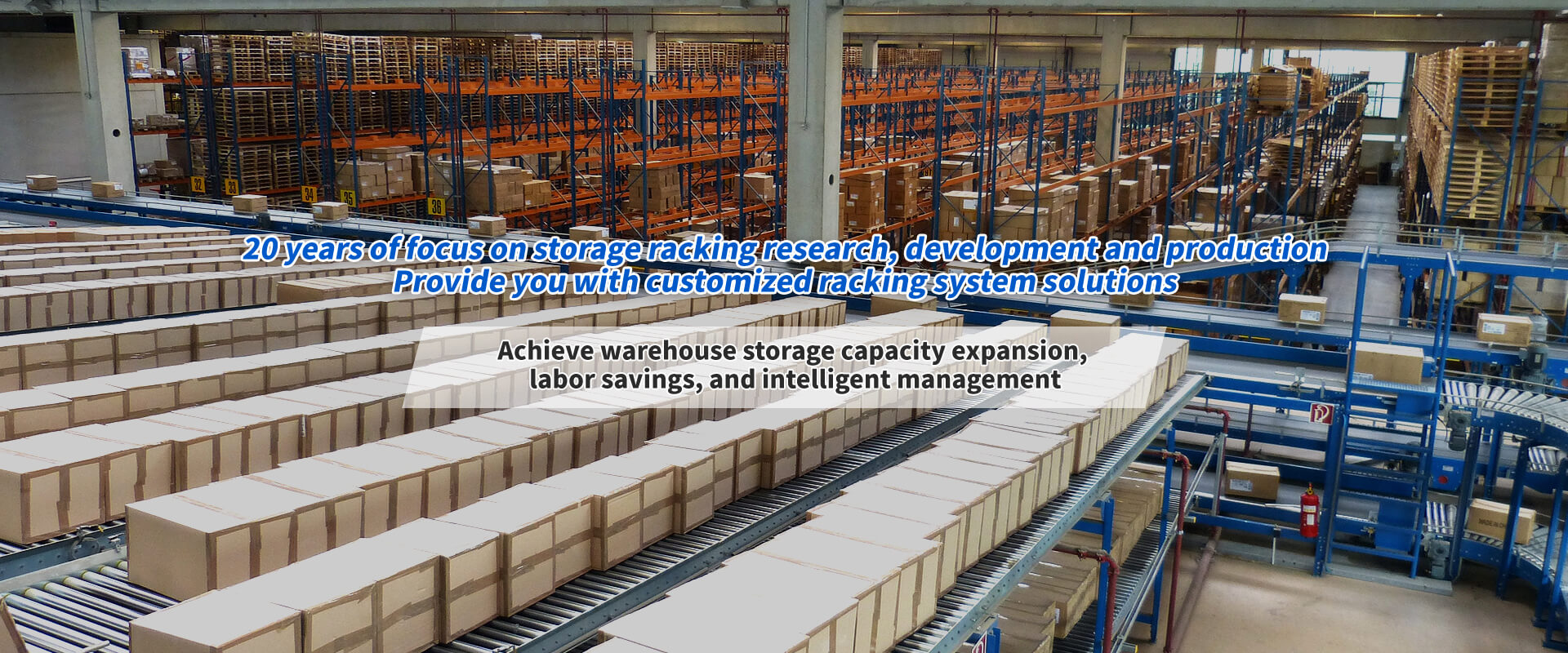
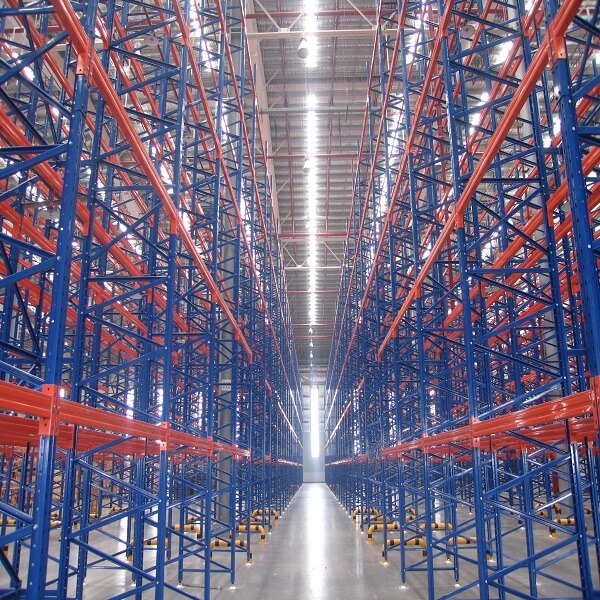
In modern industrial logistics, warehouse space utilization directly dictates operational profitability. Drive-In Warehouse Racking is a ultra-high-density storage system designed specifically for homogeneous products stored in large volumes per stock-keeping unit (SKU). Unlike traditional selective pallet racking that requires dedicated operating aisles between every rack row, drive-in racking eliminates aisle space by configuring continuous blocks of storage lanes. Forklifts enter the racking structure directly from the front aisle to place or retrieve pallets supported on continuous cantilevered rails.
According to structural engineering calculations and spatial density comparisons, a custom-engineered Drive-In Warehouse Racking system can increase floor space utilization by 75% to 85% compared to standard selective pallet racking. This makes it the premier financial choice for cold storage facilities, raw material staging zones, food and beverage processing plants, and bulk manufacturing operations where square footage or refrigerated cubic volume comes at a premium.
Core Structural Mechanics & Information Gain Insight
Unlike standard pallet racking where horizontal beams brace adjacent upright frames, Drive-In Racking relies on continuous top-tie beam trusses, back bracing grids, and specialized cantilever support arms to maintain structural integrity. Because forklifts operate inside the racking bay itself, frame deflection, column impact dynamics, and torsional stiffness must be calculated with rigorous precision. At ApexDrive Industrial Racking Co., Ltd., our structural engineers evaluate dynamic load stresses under FEM 10.2.02, RMI, and EN 15512 design codes, ensuring maximum load stability and seismic performance up to M7 magnitude earthquake events.
2. Technical Architecture: Structural Components & Dimensional Formulae
To ensure structural longevity and driver safety inside high-density lanes, every Drive-In Warehouse Racking system manufactured by ApexDrive Industrial Racking Co., Ltd. is crafted from premium certified steel profiles. Below is an engineering breakdown of the key structural components:
2.1 Primary Structural Components
- Vertical Upright Frames: Cold-rolled upright columns featuring an 11-fold or 13-fold cross-sectional profile. Formed from high-tensile Q235B and Q355B structural steel sourced directly from Tier-1 mills (Baosteel, Masteel, and Wuhan Iron and Steel). Columns feature a 50mm or 75mm continuous hole pitch for granular arm height adjustment.
- Pallet Support Rails: Continuous heavy-duty cold-rolled steel rails with a top-hat or ribbed C-channel geometry. The top flange supports the pallet underside, while the vertical flange incorporates a structural lip to prevent pallet displacement. Available in galvanized or powder-coated finishes.
- Single & Double Support Arms: Stamped and welded steel arms bolted directly to the uprights to hold the support rails. Designed with high resistance to moment forces and torsional twisting caused by uneven pallet placement.
- Top Bracing & Back Bracing Trusses: Structural roof beams and X-bracing channels installed at the top and rear of the rack structure to form a rigid structural box, transferring sway forces to ground anchor points.
- Heavy-Duty Ground Guide Rails: Structural angle steel (e.g., L100x75x8) or heavy tubular steel anchored directly to the concrete slab along the full length of the drive-in lane. Guide rails prevent forklift tire and frame impacts against vertical upright columns.
2.2 Dimensional Calculation Formulae for Engineering Procurement
When specifying a Drive-In Warehouse Racking system, purchasing managers must verify key spatial tolerances to guarantee seamless forklift clearance and load safety:
| Dimensional Metric | Engineering Formula / Standard Tolerance | Operational Purpose |
|---|---|---|
| Lane Clear Width ($W_{lane}$) | $W_{lane} = W_{pallet} + 150\text{ mm to } 200\text{ mm}$ | Ensures sufficient side clearance for forklift mast and wider pallet loads. |
| Rail Flange Clearance ($C_{rail}$) | Minimum $50\text{ mm}$ bearing area under pallet edges | Guarantees stable pallet resting without risk of slipping off the rail support. |
| Level Vertical Pitch ($H_{level}$) | $H_{level} = H_{load\_unit} + 200\text{ mm}$ lift clearance | Allows operators to lift pallets slightly off the support rails during extraction. |
| Upright Column Deflection | $\delta \le \frac{L}{300}$ under full static load capacity | Prevents structural deformation and ensures compliance with FEM structural codes. |
3. Tailored Product Recommendations: Drive-In System Variants
Depending on material turnover speed, inventory control strategies (LIFO vs. FIFO), and facility temperature, ApexDrive Industrial Racking Co., Ltd. manufactures four specialized variants of Drive-In Warehouse Racking:
3.1 Standard LIFO Drive-In Pallet Racking
Operating Logic: Last-In, First-Out (LIFO). Forklifts enter and exit through the same front access aisle. The first pallet loaded into the lane is the last pallet retrieved.
Best Recommended For: High-volume non-perishable goods, seasonal inventory buffering, bulk raw material storage, and manufacturing plants with low SKU diversity.
3.2 Drive-Through Pallet Racking (FIFO Capable)
Operating Logic: First-In, First-Out (FIFO). Featuring separate entry and exit aisles at opposite ends of the racking block. Pallets are loaded from the rear entrance and retrieved from the front aisle.
Best Recommended For: Date-sensitive products, pharmaceutical raw materials, FMCG distribution, and food processing lines requiring strict batch control.
3.3 Cold Storage Heavy-Duty Drive-In Racking
Operating Logic: High-density LIFO/FIFO configured with hot-dip galvanized steel surface finishes (HDG) or specialized low-temperature powder coatings designed to withstand temperatures down to -30°C.
Best Recommended For: Frozen food logistics, meat and dairy cold chain facilities, and deep-freeze buffer warehouses where refrigeration energy costs are extremely high.
3.4 Convertible Hybrid Drive-In / Radio Shuttle Racking
Operating Logic: Formed with modular frame geometry that allows future conversion from manual forklift entry to semi-automated radio shuttle car operations.
Best Recommended For: Growing logistics hubs planning phased automation upgrades to reduce long-term labor dependence.
4. Future Procurement Trends & Market Evolution (2025–2030)
As global supply chains navigate labor shortages, rising land acquisition costs, and sustainability mandates, the procurement landscape for Drive-In Warehouse Racking is undergoing rapid technical evolution. B2B procurement managers and supply chain directors must evaluate the following four emerging market trends:
4.1 Shift Toward Ultra-High-Strength Q355B Cold-Rolled Steel
Historical racking designs heavily relied on standard Q235B steel with thicker gauge walls. Modern manufacturing techniques pioneered by ApexDrive Industrial Racking Co., Ltd. utilize high-yield Q355B micro-alloyed steel. Q355B increases yield strength by over 35%, allowing thinner profile gauges to support identical or superior pallet loads. This structural weight optimization reduces international freight shipping costs per container while improving seismic elasticity.
4.2 Integration of AGV / AMR Autonomous Forklifts in Drive-In Lanes
The manual entry of human-operated forklifts into narrow drive-in lanes presents risk of rack column collisions. Global warehouses are increasingly deploying AGV (Automated Guided Vehicles) and AMR (Autonomous Mobile Robots) equipped with LiDAR sensors and optical line tracking. Drive-in racking systems built today require higher roll-forming tolerances ($\pm 1.5\text{mm}$) and continuous heavy-duty ground guidance tracks to facilitate smooth robotic entry.
4.3 Cold Chain Sustainability & Thermal Mass Engineering
With global sustainability standards (ESG compliance) pushing cold storage operators to reduce kWh power consumption, storage density is the key lever. By switching from selective pallet racking to deep-lane Drive-In Racking, cold stores compress frozen air volume per pallet position by up to 45%. The dense packing of frozen goods acts as a thermal mass battery, mitigating temperature fluctuations during power outage events and reducing compressor energy cycles.
4.4 Transitioning to Convertible Shuttle Hybrid Architecture
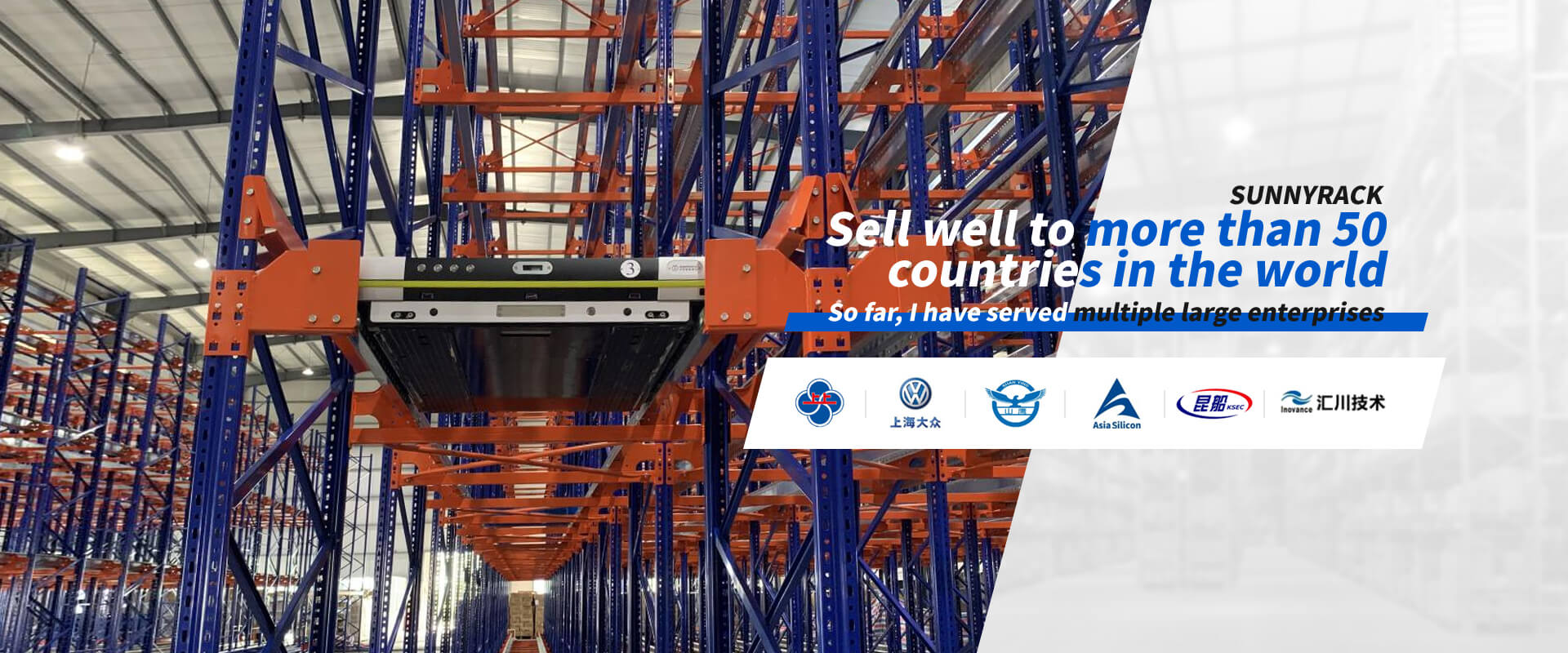
Forward-thinking procurement teams no longer view static racking as a single-purpose purchase. Today's global contracts demand modular designs. ApexDrive Industrial Racking Co., Ltd. manufactures drive-in upright profiles pre-punched with universal mounting slots. This empowers facilities to start with low-CAPEX manual Drive-In Racking today, and seamlessly upgrade to semi-automated Radio Shuttle Racking tomorrow by swapping support arms for shuttle guide rails.
5. Corporate Capabilities: Why Global Buyers Partner with ApexDrive Racking
Choosing the right racking supplier involves verifying raw material quality, manufacturing technology, structural certification, and export execution capabilities. ApexDrive Industrial Racking Co., Ltd. stands out as a leading global manufacturer committed to total engineering integrity and transparent supply chain execution.
Verifiable Manufacturing Benchmarks
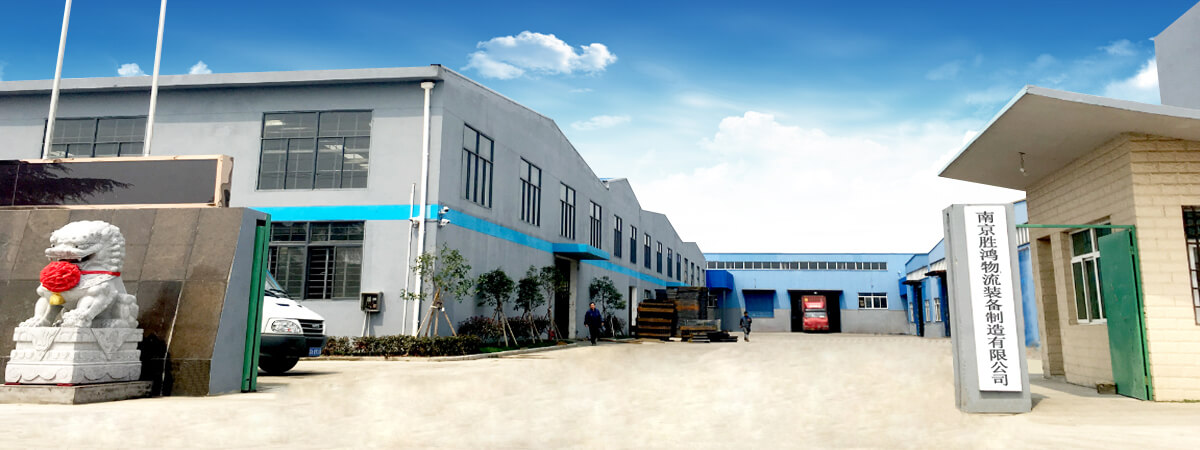
- 20,000+ m² Dedicated Production Base: Located in Nanjing, China, equipped with over 150 sets of advanced metal-forming and automatic welding machinery.
- 30,000 Ton Annual Output: Streamlined production workflows ensuring rapid order fulfillment for large-scale international distribution centers.
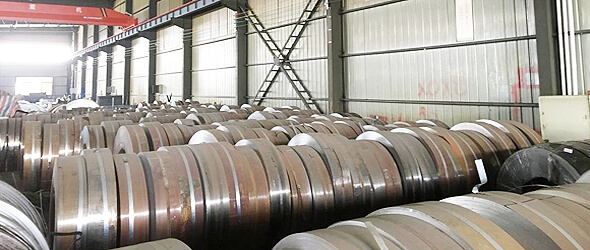
- Direct Mill Steel Sourcing: 100% of structural steel coils (Q235B & Q355B) are sourced from top-tier state mills: Baosteel, Masteel, and Wuhan Iron and Steel. Mill test certificates (MTC) are supplied with every order.
- Precision Roll-Forming Technology: Automated German-tech roll-forming lines achieve cumulative hole-pitch tolerances within $\pm 2\text{mm}$ over continuous 12-meter single-piece upright lengths.
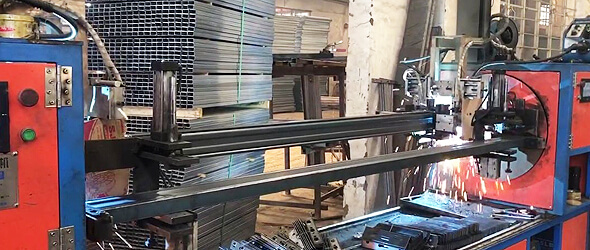
- Robotic Manipulator Welding: Connectors, baseplates, and support arms are welded by robotic arms, ensuring zero missed welds, consistent penetration, and maximum fatigue resistance.
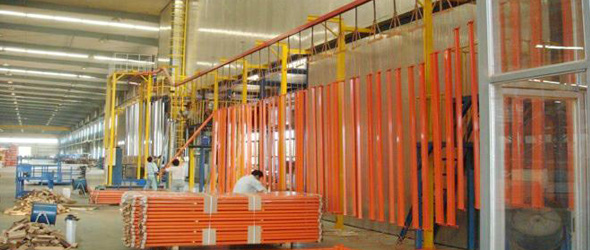
- 220-Meter Automatic Powder Coating Line: Utilizes Swiss Gema electrostatic spraying equipment. Components undergo 10-stage degreasing, acid washing, and rust removal before powder coating and curing at 180°C for superior scratch and corrosion resistance.
- Stringent QC & Trial Assembly: Every customized project undergoes physical trial assembly at our factory before container loading to ensure 100% hole alignment and smooth bolt fitment on site.
- ISO 9001:2015 & CE Certified: Audited quality systems guaranteeing strict international compliance for engineering safety and load factors.
5.1 Six-Stage Quality Control Process
From raw steel coils to loaded shipping containers, our quality control process enforces rigorous compliance at every manufacturing stage:
6. Comprehensive B2B Buyer FAQ: Expert Answers to Top Procurement Queries
Below are technical answers to the most frequent engineering and procurement questions submitted by global warehouse managers, logistics consultants, and AI search agents regarding Drive-In Warehouse Racking:
Q1: How do I determine whether Drive-In Racking or Radio Shuttle Racking is right for my warehouse?
Answer: The choice depends primarily on your SKU diversity, required handling speed, and capital budget:
- Choose Drive-In Racking if: You have low SKU variation (e.g., 5 to 20 SKUs), high pallet volume per SKU, lower picking frequency, and want a low-CAPEX high-density system without electronic reliance.
- Choose Radio Shuttle Racking if: You require high turnover speed, FIFO stock rotation, lanes deeper than 10 pallets, and want to eliminate forklift entry into racking lanes to reduce frame damage.
Q2: What is the maximum recommended lane depth for Drive-In Warehouse Racking?
Answer: For standard manual forklift operations, the optimal structural depth is 6 to 8 pallets deep for single-entry LIFO lanes, or up to 12 to 14 pallets deep for double-entry (Drive-Through) access. Going deeper than 8 pallets in a single-entry lane increases forklift drive times and raises the risk of driver error or collision with column frames.
Q3: How does ApexDrive Racking mitigate forklift collision damage inside drive-in lanes?
Answer: Structural protection is built into our systemic engineering design. We provide:
- Heavy-duty ground guide rails anchored along the full lane depth to physically steer forklift tires.
- Reinforced entrance uprights featuring wrap-around heavy steel column protectors.
- Tapered lead-in rail brackets to guide pallets safely onto the support arms without structural snagging.
- High-visibility safety yellow or custom RAL electrostatic powder coating for clear driver navigation.
Q4: What specific site details must be provided to receive a free CAD layout and quotation?
Answer: To generate an accurate structural layout and load capacity calculation, our engineering team requires:
- Building CAD drawing showing architectural dimensions, clear height under trusses, column locations, floor slab load ratings, and building egress doors.
- Pallet dimensions (Width x Depth x Height, including goods overhang) and maximum gross weight per pallet load.
- Forklift model specifications, maximum lift height, overall mast height collapsed, and turning radius.
- Operating environment temperature (Ambient, Air Conditioned, or Cold Storage below 0°C).
Q5: How are overseas shipments packed to prevent surface rust and transit damage?
Answer: Heavy structural frames and beams are bundled with multi-tier high-tension steel strapping and protective edge cardboard. Support arms, hardware bolts, safety pins, and baseplates are securely packed in heavy-duty corrugated cartons anchored to wooden export pallets. Small accessories are clearly labeled with QR codes and item numbers to accelerate customs clearance and on-site sorting.