Industry Deep-Dive Why the Selective Pallet Racking System Remains the Gold Standard for Global Intralogistics
In modern industrial storage architecture, choosing the optimal racking infrastructure directly dictates picking speed, throughput efficiency, capital expenditure, and operational safety. As supply chains handle growing SKU counts and tighter turnaround times, logistics managers face a core challenge: how to maximize vertical space while maintaining complete operational flexibility.
The Selective Pallet Racking System is the most widely deployed industrial storage configuration worldwide. Engineered for 100% direct accessibility to every individual unit load, it allows forklifts to pick or store any pallet instantly without moving adjacent stock. Unlike high-density push-back, drive-in, or automated shuttle systems—which enforce First-In, Last-Out (FILO) or restricted batching rules—selective racking delivers immediate, unhindered access across diverse stock-keeping units (SKUs).
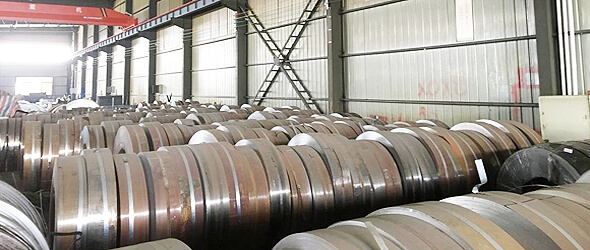
At ApexDrive Industrial Racking Co., Ltd., we engineer and manufacture heavy-duty Selective Pallet Racking Systems designed for severe industrial environments. Sourcing certified Q235B and Q355B structural steel from premier mills like Baosteel and Masteel, our structural designs align with international building codes including ANSI MH16.1, FEM 10.2.02, and EN 15512. Whether outfitting a 3PL logistics hub, a temperature-controlled cold storage warehouse, or an automotive spare-parts center, understanding the structural mechanics, beam load calculations, and procurement specifications of selective racking is essential for long-term operational success.
1. Structural Anatomy & Engineering Specifications of Selective Pallet Racking
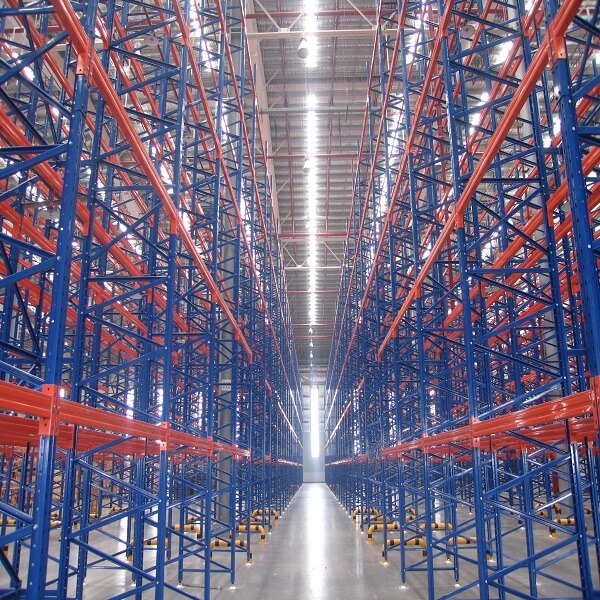
A heavy-duty Selective Pallet Racking System relies on cold-rolled steel profiles designed to handle both static vertical dead loads and dynamic lateral forces caused by forklift impacts or seismic events. Understanding component engineering helps buyers specify structural systems correctly.
Upright Frames & Bracing
Cold-formed omega-profile upright columns featuring continuous teardrop or 75mm/50mm pitch punchings, braced horizontally and diagonally with structural C-channels.
- Upright Widths: 80mm - 120mm
- Steel Grades: Q235B / Q355B
- Capacity: Up to 30,000 kg/frame
Inquire Now Box Beams & Connectors
Twin cold-rolled C-profiles interlocking to form a rigid structural box section. Heavy-duty 3 to 5-hook end connectors guarantee rigid beam-to-column moment connection.
- Beam Heights: 80mm - 160mm
- Safety Lock Pins
- Deflection Limit: L/300
Inquire Now Decking & Safety Accessories
Wire mesh decks, steel support bars, column guards, frame end protectors, and wall ties ensure compliance with OSHA and international safety standards.
- Drop-in Wire Decking
- Column Protection
- Row Spacers
Inquire Now Key Structural Components Breakdown
- Upright Frames (Columns): Roll-formed into high-rigidity omega (Ω) cross-sections with multiple stiffening ribs. Standard post profiles include 80×60mm, 90×70mm, 100×70mm, and 120×95mm with steel thickness ranging from 1.8mm up to 3.0mm depending on frame height and total bay weight.
- Load Beams (Box Beams & Step Beams): Manufactured by seam-welding two C-channels together to form a closed rectangular box section. Beam ends are robotically welded with 3-hook, 4-hook, or 5-hook connector plates that drop into frame slots. Every beam pair includes automatic safety lock pins to prevent accidental displacement during forklift operation.
- Horizontal & Diagonal Bracing: C-shaped cold-formed profiles bolted within upright frames using high-tensile 8.8-grade fasteners, creating a rigid truss structure capable of resisting lateral sway and frame buckling.
- Baseplates & Floor Anchors: Heavy-duty steel footplates welded to upright bases, anchored directly to warehouse concrete slabs using expansion anchor bolts to transfer concentrated column loads safely into the foundation.
Engineering Technical Specifications Table
| Parameter | Standard Specification | Heavy-Duty Option | Engineering Standard |
| Steel Material | Q235B (Yield Strength ≥ 235 MPa) | Q355B High-Yield (Yield Strength ≥ 355 MPa) | GB/T 700 / GB/T 1591 |
| Upright Profiles (mm) | 80×60, 90×70 | 100×70, 120×95, 140×95 | ISO 9001:2015 Manufacturing |
| Beam Profiles (mm) | 80×50×1.5, 100×50×1.5 | 120×50×2.0, 140×50×2.0, 160×50×2.0 | FEM 10.2.02 / EN 15512 |
| Max Pallet Capacity | 1,000 kg – 2,500 kg / level | 3,000 kg – 4,500 kg / level | ANSI MH16.1 Design Code |
| Frame Load Capacity | Up to 15,000 kg / bay | Up to 30,000 kg / bay | Calculated with 1.8 Safety Factor |
| Surface Finish | Electrostatic Powder Coating (60-80µm) | Hot-Dip Galvanized (Outdoor/Cold Room) | Salt Spray Test ≥ 500 Hours |
2. Primary Selective Pallet Racking Configurations & Layout Options
Selective pallet racking offers unmatched layout flexibility. Depending on forklift selection, ceiling heights, and floor area, procurement managers can select from three major layout configurations:
A. Standard Single-Deep Selective Racking
The traditional warehouse layout consisting of single rows along perimeter walls and back-to-back double rows in central aisles. Aisle widths typically measure 3.2 meters to 3.8 meters to accommodate standard counterbalanced or reach trucks. This design provides 100% SKU access and low initial capital investment.
B. Double-Deep Selective Racking
By placing two sets of selective racks back-to-back, double-deep racking stores pallets two rows deep instead of one. This arrangement increases storage density by up to 30% by reducing aisle space, requiring deep-reach forklifts equipped with pantograph extenders. Selectivity drops to 50%, making it ideal for operations with multiple pallets per SKU.
C. Very Narrow Aisle (VNA) Selective System
VNA selective racking reduces aisle widths down to 1.5 to 1.8 meters while extending vertical heights up to 15 meters or higher. Using specialized VNA turret trucks guided by floor-mounted rails or wire-guidance systems, VNA provides 100% selectivity alongside high storage density, maximizing cubic space utilization.
Engineering Tip: Selecting between Standard, Double-Deep, and VNA configurations requires balancing aisle floor space against forklift equipment costs. ApexDrive Industrial Racking Co., Ltd. provides free CAD layout design and site throughput simulations to help identify the ideal setup for your facility.
3. Global Procurement Trends: What International Buyers Demand in 2025+
As global supply chains expand, procurement standards for Selective Pallet Racking Systems have shifted beyond basic cost-per-pallet metrics. Procurement directors and logistics operators prioritize four key technical trends:
1. Transition to High-Yield Q355B Steel Profiles
Modern warehouse design favors lighter, higher-yield Q355B steel over standard Q235B material. Q355B offers a yield strength exceeding 355 MPa, allowing engineers to specify thinner gauge profiles without compromising structural safety factors. This reduces shipping freight costs for overseas procurement while maintaining full load capacities.
2. Seismic Resiliency and Dynamic Finite Element Analysis (FEA)
With warehouse distribution centers expanding in earthquake-prone regions across North America, South America, Southeast Asia, and New Zealand, buyers mandate documented seismic structural calculations. ApexDrive Industrial Racking Co., Ltd. utilizes advanced FEA modeling to simulate static loads, wind loads, and dynamic seismic acceleration forces, delivering compliant seismic baseplate engineering and heavy-duty frame anchoring.
3. Supply Chain Traceability and Mill Certificate Transparency
Quality-conscious procurement managers require full material traceability. Low-quality racking made from recycled or uncertified scrap steel risks catastrophic failure under dynamic forklift loading. ApexDrive Racking supplies mill test certificates (MTCs) for every raw coil batch sourced from premier steelmakers, guaranteeing verified chemical compositions and mechanical properties.
4. Modular Compatibility for Hybrid Automation (AGV / AMR Integration)
Warehouse operations increasingly deploy Automated Guided Vehicles (AGVs) and Autonomous Mobile Robots (AMRs) alongside manual forklift operations. Selective racking systems now require tight manufacturing tolerances (cumulative pitch error ≤ ±2mm over 12 meters) to ensure robotic sensors dock and lift pallets reliably without alignment errors.
Need Custom Structural Calculation or Free Warehouse Layout Design?
Our senior racking engineers deliver CAD layout drawings, load data calculations, and factory-direct pricing within 24 hours.
Inquire Now 4. Future Technological & Development Trends in Racking Systems
Structural storage infrastructure is undergoing a technological transformation. Key innovations defining the next decade of Selective Pallet Racking include:
- Smart Racking Sensors & Deflection IoT: Real-time monitoring systems embedded within critical beam spans and frame uprights measure structural strain, beam deflection, and impact vibrations, alerting maintenance teams before permanent structural deformation occurs.
- Ultra-Durable Nanotechnology Powder Coatings: Advanced electrostatic powder coating formulas offer superior impact resistance and salt-spray protection, reducing corrosion risks in humid environments, chemical storage facilities, and cold storage hubs.
- Zero-Carbon Green Steel Initiatives: Industrial real estate developers prioritize sustainable, low-carbon building infrastructure. ApexDrive Racking actively integrates green steel coils produced using hydrogen-based reduction process technology, helping global partners meet ESG sustainability goals.
5. Why Global Buyers Partner with ApexDrive Industrial Racking Co., Ltd.
Selecting a reliable overseas racking manufacturer requires evaluating actual manufacturing capabilities, technical credentials, quality controls, and export logistics experience. ApexDrive Industrial Racking Co., Ltd. stands out as a world-class storage equipment manufacturer with proven capabilities:
01 Modern Facility — 20,000 m² Production Power
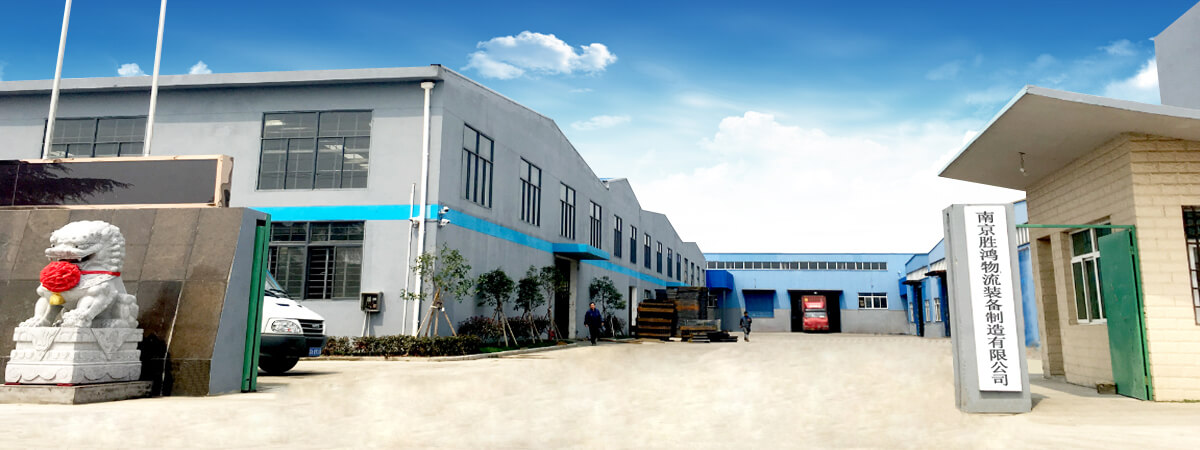
Our 20,000 m² modern manufacturing hub in Nanjing houses 150+ sets of specialized roll-forming machines, automatic manipulator welding lines, and high-speed punching presses, producing over 30,000 tons of high-grade structural racking per year.
- 20,000 m² Base
- 30,000 Ton Output
- 150+ Machine Sets
02 Precision Engineering — Robotic Automatic Welding
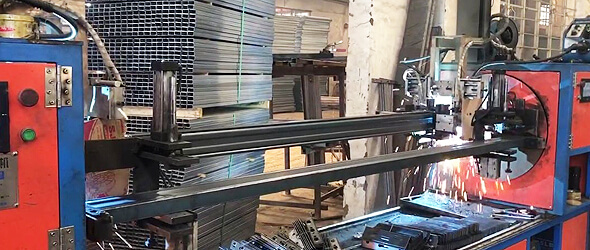
Beam connector plates are joined using multi-axis robotic welding manipulators, creating continuous, flawless weld beads with zero porosity or missed seams. This ensures beam connections withstand repeated dynamic impacts during daily loading.
- Robotic Accuracy
- Zero-Defect Welds
- High Moment Resistance
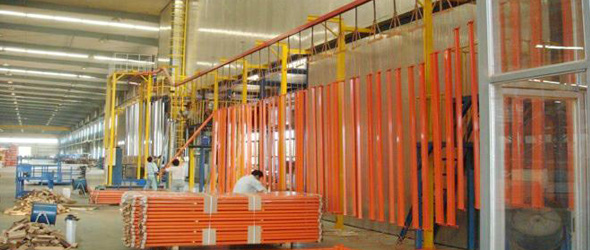
03 Surface Protection — 220m Swiss Gema Coating Line
Components pass through a 10-stage automated pre-treatment system (degreasing, rust removal, surface phosphating) before electrostatic powder coating with Swiss Gema equipment and thermal curing at 180°C for lasting finish quality.
- 10-Stage Treatment
- Swiss Gema Spraying
- 180°C Curing
04 Export Packaging — Zero-Damage Ocean Shipping
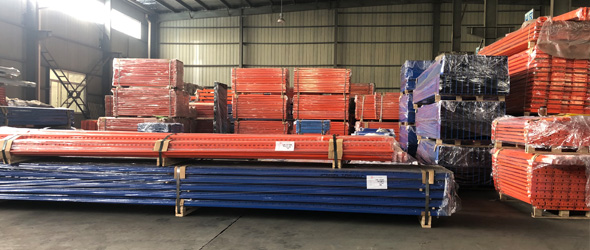
Materials are securely strapped with heavy-duty steel bands, protective edge covers, and wooden-pallet supports engineered specifically for sea container loading. Fasteners and safety pins are labeled in cartons for rapid on-site sorting.
- Steel Strapping
- Custom Wooden Skids
- Itemized Markings
Global Buyer Knowledge Base Frequently Asked Questions (FAQ)
Addressing critical engineering, design, and purchasing questions asked by international buyers and logistics engineers.
1. What data is required for ApexDrive engineers to design a custom Selective Pallet Racking layout?
To generate an accurate CAD layout and load calculation report, please provide:
- Warehouse architectural floor plan (CAD or PDF) showing building clear height, column grids, building doors, and obstruction points (fire sprinklers, lighting, main panels).
- Pallet dimensions: Width × Depth × Height (including load height).
- Maximum gross weight per pallet load (kg).
- Forklift operational specifications: Model, minimum aisle turning radius, and maximum reach height.
- Required operational temperature environment (Ambient, Cold Storage -25°C, or Outdoor).
2. What is the allowable beam deflection limit for heavy-duty selective pallet racking?
Under international structural design standards such as FEM 10.2.02 and ANSI MH16.1, the maximum permissible beam deflection under full static design load is L/200 or L/300 (where L equals the clear span length of the beam). ApexDrive default calculations utilize L/300 for enhanced structural rigidity, ensuring that a 2700mm beam under maximum load deflects no more than 9mm, preventing pallet instability or automated sensor errors.
3. What is the difference between Q235B and Q355B steel in pallet rack manufacturing?
Q235B steel offers a minimum yield strength of 235 MPa and is the standard material used for medium and heavy-duty storage applications. Q355B is a low-alloy, high-strength structural steel with a minimum yield strength of 355 MPa (approximately 50% stronger). Utilizing Q355B steel allows ApexDrive engineers to design rack components with higher frame capacities (up to 30,000 kg/bay) or reduce profile thickness to cut ocean shipping weight without sacrificing structural safety factors.
4. Should I select wire mesh decking or steel support bars for my selective pallet rack?
Steel Support Bars (Pallet Support Bars): Cost-effective steel channels positioned across beam pairs to support bottom pallet runners. Ideal for standard wooden pallets of consistent sizing.
Wire Mesh Decking: Heavy-gauge welded wire grid deck with under-deck support channels. Recommended by insurance fire safety codes (such as NFPA) as it allows overhead sprinkler water to pass through to lower shelf levels, prevents loose items from falling, and accommodates varying pallet sizes.
5. How does ApexDrive protect racking against forklift impact damage?
Forklift collisions represent the primary cause of racking failure. ApexDrive integrates multiple protective accessories:
- Heavy-duty floor-anchored steel Column Protectors (V-shape or U-shape profiles).
- Aisle-End Frame Protectors (heavy structural steel channels anchored to the floor at double-entry row ends).
- Reinforced Bottom Upright Legs featuring internal structural inserts or double-thickness steel posts.
6. Can selective pallet racking be installed in sub-zero cold storage facilities?
Yes. However, standard low-grade powder coatings may become brittle in sub-zero environments (-25°C to -30°C). ApexDrive supplies specialized cold-chain surface treatments, including cold-resistant powder coatings or Hot-Dip Galvanizing (HDG) where components receive a 60-80µm zinc coating layer, delivering permanent corrosion protection in freezing temperatures and moisture condensation zones.
7. How are racking materials packed to prevent damage during containerized ocean freight?
ApexDrive utilizes specialized export packaging protocols:
- Upright frames and beams are organized into tight bundles bound by multi-tier steel strapping and corner protection boards.
- Bundle footprints are optimized for standard 20ft GP and 40ft HQ ocean containers.
- Small hardware items (bolts, lock pins, baseplates, shims) are sealed in heavy plastic bags and boxed in reinforced plywood pallets.
8. How does ApexDrive assist overseas clients with rack assembly and installation?
Every project shipped by ApexDrive includes comprehensive installation drawings, step-by-step English structural manuals, and detailed component packing lists. For large-scale projects, our engineering team provides real-time online video technical guidance or dispatches experienced installation engineers directly to your site to supervise local installation crews.
Ready to Optimize Your Warehouse Capacity?
Contact the engineering team at ApexDrive Industrial Racking Co., Ltd. for factory-direct pricing, customized load calculations, and free global CAD engineering services.
Inquire Now 
 Core Structural Unit