Choosing the 2026 best Wide Aisle Pallet Racking system requires more than comparing product photos or advertised load capacities. Warehouse managers must examine pallet dimensions, forklift turning space, ceiling height, inventory turnover, and future expansion plans. A practical review should explain how each racking type performs during daily loading, replenishment, and order picking.
Selective pallet racking remains a dependable choice for warehouses needing direct access to every pallet. Drive-in racking can increase storage density, but it may reduce stock rotation and forklift flexibility. Push-back and pallet flow systems offer faster handling for specific inventory patterns. Double-deep layouts can improve capacity, although they require compatible forklifts and disciplined location control. Each option solves a different operational problem.
Small details matter. A forklift may need several extra seconds to align with a deep pallet position. Repeated delays can become expensive across multiple shifts. Rack beam deflection, floor flatness, pallet quality, and impact protection also deserve careful inspection. These factors are sometimes overlooked.
This guide compares major Wide Aisle Pallet Racking types for 2026, using practical warehouse criteria rather than marketing claims. It considers accessibility, density, safety, installation complexity, maintenance, and long-term operating value. No system is perfect. Even a well-designed layout may need revision after real traffic patterns appear. Reliable decisions should combine supplier specifications, qualified engineering advice, and observations from the warehouse floor. The best solution is not always the densest one. It is the system that supports safe, predictable, and efficient movement every day.
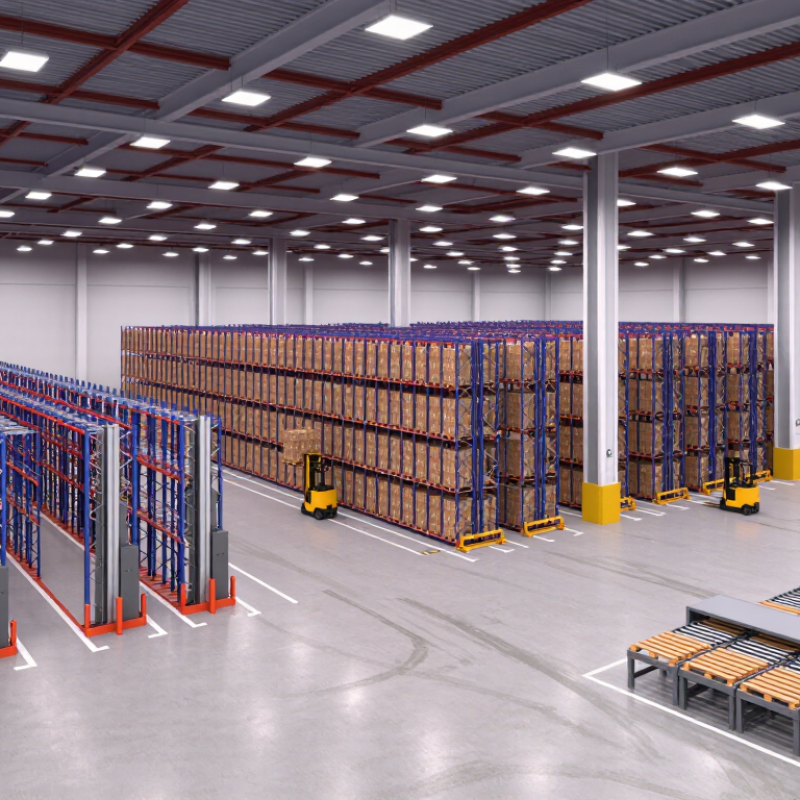
Wide aisle pallet racking keeps generous travel lanes between storage rows, usually allowing counterbalanced forklifts to turn, lift, and reverse safely. In practice, aisle width depends on the truck model, pallet size, rack height, and building columns. A common layout uses selective pallet racks because every pallet position remains directly accessible. Drive-in, double-deep, and push-back systems can also use wide aisles, but they change access speed and inventory control. That distinction matters.
The system works through upright frames, horizontal beams, baseplates, and load-protection components. Forklifts place pallets onto beams from the aisle, while operators inspect damage during daily travel. The Rack Manufacturers Institute emphasizes that rack design must match actual loads, seismic conditions, and installation requirements. Guesswork is expensive. OSHA reports that powered industrial trucks contribute to approximately 25% of workplace fatalities involving such equipment, making traffic separation and operator training essential. Wide lanes reduce conflict, but they do not remove it.
Industry data also supports careful planning. The 2024 MHI Annual Industry Report found that 55% of supply chain professionals planned to increase technology investment, including warehouse automation. Yet wide aisle layouts still depend heavily on human decisions. Barcode scanning, location software, and rack sensors can improve accuracy, though imperfect data remains a weakness. Before selecting a rack type, measure clear height, pallet variation, forklift turning radius, and required access frequency. A drawing may look efficient. The floor may disagree.
2026 Best Wide Aisle Pallet Racking Types?
Main Types of Wide Aisle Pallet Racking Systems
Wide aisle pallet racking gives forklifts direct access to every pallet position. The main type is selective pallet racking, usually arranged with aisles around 3.0–3.7 meters wide. It suits mixed SKUs, frequent picking, and changing inventory. Adjustable beams support different load heights, although poor pallet placement can reduce usable space. According to the 2024 MHI Annual Industry Report, more than eight in ten supply-chain professionals expect technology investment to increase. That pressure makes flexible rack layouts more valuable.
Double-deep racking stores one pallet behind another. It improves storage density, but rear pallets require stricter stock rotation and careful load planning. Drive-in and drive-through systems offer higher density for uniform products, especially when many pallets share the same SKU. Pallet-flow racking uses gravity rollers and supports first-in, first-out movement. It can work well for dated goods, but maintenance becomes more demanding.
Safety remains a design condition, not an optional feature. OSHA 29 CFR 1910.176 requires stored materials to remain stable and secure. Industry guidance also emphasizes rack capacity plates, upright protection, beam locking, and regular inspections. A 2023 research report from Interact Analysis projected continued warehouse automation growth through 2027, yet automation does not fix weak rack planning. In practice, the “best” wide aisle system may be the less dense one. That choice can feel wasteful, but safer access and fewer handling errors often matter more.
Wide-aisle pallet racking typically requires approximately 3.0–3.7 metres of clear aisle space, depending on the forklift type, pallet dimensions, rack height, and local operating requirements. Selective racking provides direct access to every pallet, while double-deep, drive-in, push-back, and pallet-flow systems improve storage density by reducing individual pallet accessibility.
Choosing the right wide aisle rack starts with product flow, not rack height. Selective pallet racking suits warehouses with many SKUs and frequent access. It provides direct access to every pallet, but it uses more floor space. Double-deep racking improves density and works better when stock rotation is predictable. It needs compatible forklifts and tighter operating discipline.
Measure the building carefully. Record clear height, column positions, sprinkler clearance, slab capacity, and forklift turning radius. A wide aisle often requires roughly 3.0 to 3.6 meters, depending on the truck. That space affects storage density. The MHI 2024 Annual Industry Report found that 55% of respondents planned to increase supply-chain technology investment. That supports adding barcode scanning, slotting software, or location tracking. Technology cannot correct poor rack planning.
Safety deserves equal weight. OSHA 29 CFR 1910.176(b) requires stored materials to remain stable and secure against sliding or collapse. Use certified rack designs, protect end frames, and inspect beams after impacts. The Rack Manufacturers Institute recommends documented inspections and prompt action on damaged components. I would also test real pallets before final approval. Supplier drawings may look perfect. Actual pallets can sag, vary in width, or block sprinkler clearance. That inconvenient detail is easy to miss. Use current demand data, but challenge it. Seasonal peaks may justify adjustable selective racks, while stable, uniform loads may support deeper systems.
2026 Best Wide Aisle Pallet Racking Types?
Key Design, Load Capacity, and Safety Requirements
Wide aisle pallet racking remains suitable for facilities using standard forklifts and frequent pallet access. Selective racking offers direct access to every pallet, but it requires more floor space. Double-deep systems improve density, although they need compatible handling equipment and stricter inventory control. In warehouse assessments, aisle width is often underestimated. Turning clearance matters as much as storage height.
Load capacity must begin with the heaviest pallet, not the average pallet. Engineers should verify beam capacity, upright strength, slab condition, pallet quality, and seismic requirements. Capacity labels should match the approved configuration. The Rack Manufacturers Institute specification, aligned with ANSI MH16.1, supports engineered design and testing for industrial steel storage racks. A small beam change can alter the entire load calculation.
Safety is not an accessory.
The U.S. Occupational Safety and Health Administration requires stored materials to remain stable and secure under 29 CFR 1910.176(b). Guardrails, column protectors, flue spaces, and documented inspections reduce impact and collapse risks. FM Global’s storage guidance also emphasizes commodity classification, sprinkler clearance, and storage height. The MHI 2024 Annual Industry Report found that 55% of respondents increased technology and innovation investment. That trend supports better rack monitoring, but sensors cannot repair poor design. A practical weakness remains: many sites inspect after damage, not before it.
| Racking Type | Best Application | Typical Configuration | Typical Load Capacity | Recommended Aisle Width | Key Design Characteristics | Essential Safety Requirements |
|---|---|---|---|---|---|---|
| Selective Pallet Racking | General-purpose warehouses requiring direct access to every pallet and a high variety of stock-keeping units. | Single-deep frames with adjustable beam levels; commonly arranged in back-to-back rows. | Approximately 1,000–5,000 lb per beam level | Typically 10–12 ft for conventional counterbalance forklifts | Highest selectivity; flexible beam adjustment; relatively low installation and operating complexity. | Use engineered frame and beam capacities; install beam safety locks, column protectors, row spacers, pallet supports where required, and clearly visible load notices. |
| Double-Deep Pallet Racking | Facilities seeking greater storage density while retaining access to a broad range of products. | Two rows of selective rack placed one pallet position behind the other; requires a reach truck or suitable double-deep attachment. | Approximately 1,500–5,000 lb per beam level | Typically 10–12 ft, depending on truck and pallet depth | Improves cube utilization compared with single-deep selective rack, but reduces immediate access and requires disciplined inventory rotation. | Verify truck reach capability, maintain required flue spaces, protect the front frame, use pallet stops or supports when specified, and control loading depth. |
| Very Narrow Aisle (VNA) Racking | High-density storage in tall buildings where floor space is limited and throughput justifies specialized equipment. | Single-deep or double-deep adjustable rack served by turret trucks or articulated forklifts. | Approximately 1,500–4,500 lb per beam level | Typically 5–7 ft, subject to truck design and operating clearances | Maximizes storage density and vertical volume; often requires guided truck travel, precise floor flatness, and carefully controlled rack geometry. | Confirm truck-to-rack clearances, provide end-of-aisle protection, use guide systems where necessary, control pedestrian access, and inspect floor and rack alignment. |
| Drive-In Pallet Racking | Large quantities of the same or similar product with low SKU variety and limited first-in, first-out requirements. | Forklifts enter rack lanes and place pallets on continuous support rails; commonly designed for block storage. | Approximately 1,500–3,000 lb per pallet position | Typically 11–13 ft at the approach, with lane dimensions determined by the forklift and pallet | High storage density with fewer aisles; reduced selectivity; generally follows a last-in, first-out flow pattern. | Use properly sized guide rails and pallet supports, install upright and portal protectors, restrict pedestrian entry, control forklift speed, and prevent damaged pallets from entering lanes. |
| Push-Back Pallet Racking | Medium-to-high-density storage where multiple pallets per SKU are required and direct access to every pallet is not essential. | Inclined nesting carts or wheeled carriers allow pallets to be loaded and retrieved from the same aisle. | Approximately 1,500–4,000 lb per pallet position | Typically 10–12 ft, depending on forklift type and pallet depth | Uses valuable vertical space efficiently; supports last-in, first-out inventory flow; faster loading than drive-in systems for many operations. | Check cart and rail ratings, maintain pallet dimensional consistency, use backstops where designed, protect uprights, and train operators on controlled loading and unloading. |
| Pallet Flow Racking | High-throughput operations requiring first-in, first-out rotation, such as food, beverage, and date-sensitive inventory. | Inclined roller or wheel lanes with loading and picking faces on opposite sides. | Approximately 1,500–3,000 lb per pallet position | Typically 10–12 ft for loading and retrieval equipment | Strong stock rotation and reduced forklift travel at the picking face; requires compatible pallets and accurate lane loading. | Install speed controllers, lane separators, pallet stops, and end protection; inspect rollers and brakes regularly; keep operators clear of discharge zones. |
| Double-Deep VNA Racking | High-volume warehouses that need increased density while retaining mechanized access to deeper pallet positions. | Two pallet positions deep, typically served by turret or reach equipment in narrow aisles. | Approximately 1,500–4,000 lb per beam level | Typically 5–7 ft, subject to equipment specifications | Combines vertical space utilization with higher density than single-deep VNA; requires accurate pallet placement and inventory planning. | Maintain strict aisle tolerances, use approved pallet supports, provide collision protection, verify load center assumptions, and implement routine rack and equipment inspections. |
| Structural Pallet Racking | Heavy-duty environments, cold storage, industrial applications, and locations where impact resistance or high loads are important. | Hot-rolled structural members or structural frames with bolted or pinned connections. | Approximately 2,000–6,000+ lb per beam level | Typically 10–12 ft for conventional forklifts; narrower with suitable equipment | Robust construction and strong resistance to abuse; heavier components may increase material and installation costs. | Use a site-specific engineered design, verify slab and anchorage capacity, install column protection, maintain connection hardware, and post rated load information. |
2026 Best Wide Aisle Pallet Racking Types?
Wide aisle pallet racking is becoming more intelligent, not simply taller. Selective racking remains practical for mixed stock and frequent picking. Double-deep systems improve density, but they need disciplined inventory rotation. In 2026, the stronger trend is connected operation. Rack sensors, warehouse management systems, machine vision, and autonomous vehicles can share live location data. The 2024 MHI Annual Industry Report reported that 55% of supply chain leaders planned to increase technology investment within two years. That pressure is reaching storage design.
Energy use and safety are also changing rack specifications. LED-guided aisles, lithium battery equipment, and traffic monitoring can reduce wasted movement. Digital twins may test aisle width before steel is installed. However, software cannot correct poor pallet quality or damaged frames. Field inspections still find bent uprights, uneven floors, and overloaded beams. That is the uncomfortable part. Technology improves visibility, but it does not replace trained judgment. The 2024 DHL Logistics Trend Radar also identified AI, robotics, and digitalization as major logistics forces, although adoption speed differs widely.
Tips: Measure real pallet loads, not catalog averages. Keep clearances generous around forklifts. Connect rack data with maintenance records. Review alerts weekly. A cheaper dense layout may become expensive when access slows, products age, or safety checks are missed. Test one aisle first, then compare travel time, damage, and labor results.
Wide aisle pallet racking leaves generous travel lanes between storage rows. Forklifts can turn, lift, and reverse more comfortably. Aisles often measure about 3.0–3.7 meters. The exact width depends on the forklift, pallet, rack height, and building columns.
Upright frames, horizontal beams, baseplates, and protection components form the structure. Forklifts place pallets directly onto the beams. Operators can inspect racks during daily travel. Wide lanes reduce conflicts, but they do not remove them.
Selective pallet racking usually works best for mixed products and frequent picking. Every pallet position remains directly accessible. Adjustable beams support different load heights. Poor pallet placement can still waste valuable space.
Double-deep racking stores one pallet behind another. It increases density within the same floor area. Rear pallets need careful stock rotation and load planning. Access becomes slower. That trade-off is easy to underestimate.
These systems suit uniform products with many pallets sharing one item type. They provide higher storage density. Direct access to every pallet is not available. Inventory control becomes more important.
Wider lanes can improve forklift visibility and maneuvering space. Safety still depends on training, traffic separation, stable loads, and inspections. Capacity plates, beam locks, and upright guards are essential. Safety needs constant attention.
Measure clear ceiling height, real pallet weights, pallet variation, and forklift turning radius. Check building columns and floor conditions. Record how often each product needs access. A drawing may look efficient. The floor may disagree.
Sensors, location software, machine vision, and automated vehicles can share live storage data. Digital models may test aisle widths before installation. Traffic monitoring can reduce unnecessary movement. Software cannot repair bent frames or poor pallets.
Test one aisle before expanding the whole system. Compare travel time, product damage, labor effort, and access delays. Review alerts and maintenance records weekly. The first estimate may be wrong. Adjust the plan.
Wide Aisle Pallet Racking is a versatile warehouse storage solution designed to provide direct access to individual pallets while supporting efficient forklift operation. This article explains how wide aisle layouts work and compares major system types, including selective pallet racking, drive-in alternatives, double-deep configurations, and high-bay designs. Each option offers different benefits in terms of accessibility, storage density, flexibility, and inventory control.
The guide also outlines how to choose the most suitable rack according to warehouse size, product characteristics, turnover rate, equipment, and future expansion plans. It highlights essential design factors such as load capacity, aisle width, frame height, floor conditions, structural stability, and workplace safety. Looking toward 2026, the discussion covers emerging trends including smarter inventory management, automated handling equipment, improved safety monitoring, modular rack components, and energy-efficient warehouse layouts. Together, these insights help businesses develop a secure, adaptable, and cost-effective storage strategy.