Choosing Deep Lane Pallet Racking in 2026 is not just a matter of fitting more pallets into a building. The right layout must match your inventory, handling equipment, and daily order pattern. A deep-lane system can use floor space efficiently, but it may reduce direct access to individual pallets. That trade-off matters.
Warehouse-design authority James A. Tompkins offers a useful principle, paraphrased here rather than presented as a verbatim quotation: storage design should serve the operation, not dictate it. For deep-lane storage, that means checking how many pallets you hold per SKU, how consistently they arrive, and whether your team needs first-in, first-out or last-in, first-out access. One detail can change the design: a lane filled with uniform pallets behaves differently from one receiving mixed loads.
Measure the building before comparing proposals. Note clear height, aisle widths, floor condition, sprinkler obstructions, and the turning space required by the intended forklift or shuttle system. Then test the plan against real workflows, not only a maximum-capacity drawing. Ask suppliers to explain their assumptions, including expected throughput and recovery time when a pallet is damaged or misplaced. These checks support a more informed decision, though they cannot remove every operational compromise. Deep Lane Pallet Racking can be an effective fit for high-volume, low-SKU storage. It is not automatically the best answer for every warehouse.
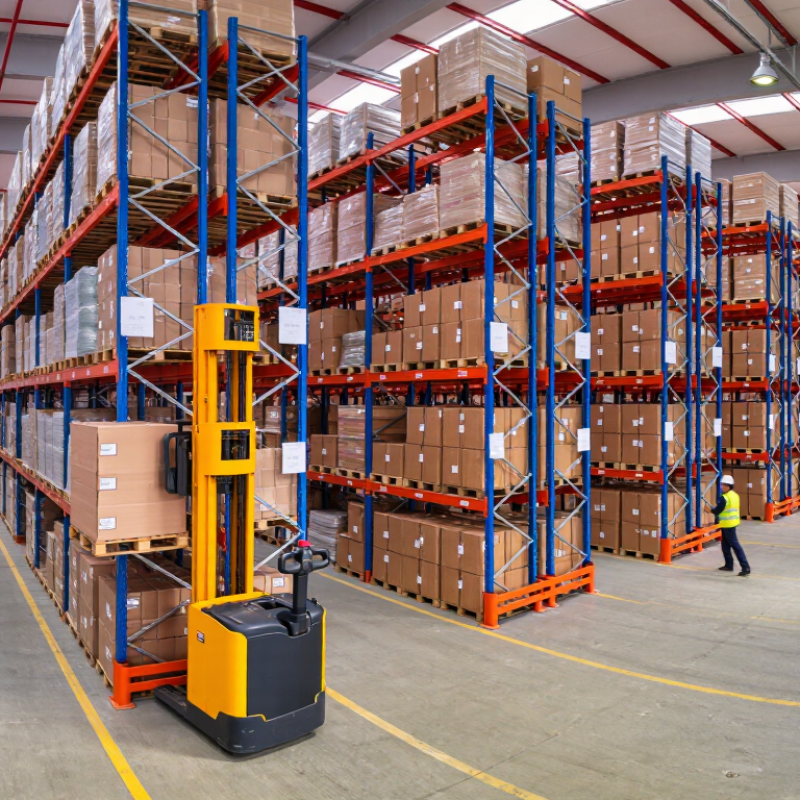
Deep-lane pallet racking stores several pallets behind one another, using fewer access aisles than selective racking. In a drive-in layout, a forklift enters the lane and places pallets on rails. Retrieval usually follows last-in, first-out: the nearest pallet comes out first. That matters. A shuttle-based system uses a powered cart to move pallets along the rails, while the forklift stays at the aisle. Depending on lane design, loading and retrieval can support different rotation patterns.
Think of a lane as a narrow tunnel, not a row of independent slots. Pallet dimensions, load stability, rail clearance, and forklift turning space all affect safe operation. One crushed corner can snag a pallet behind it. The neat drawing is not the whole story; real pallet variation can complicate a supposedly uniform lane.
Deep lanes suit operations holding many pallets of the same SKU, with steady replenishment and fewer product changes. They are less suitable when every pallet needs immediate, separate access. MHI’s 2024 Annual Industry Report found that 55% of surveyed organizations planned to increase supply-chain technology investment over the following two years. That signals growing interest in warehouse technology, not proof that automation fits every site. Before choosing, compare SKU counts, pallet turnover, and retrieval rules against a real floor plan. A small pilot can expose awkward loading habits. Worth checking.
Assess inventory before choosing deep lane pallet racking. Count pallet positions by SKU, then separate fast-moving lines from slow or seasonal stock. Deep lanes suit large quantities of the same product; they may slow access when many SKUs share limited space. Start with the load. Record pallet dimensions, maximum weight, and any overhang. Confirm whether operators need FIFO access from both ends or can accept LIFO access from one end. The choice affects rotation, replenishment, and aisle layout.
Use actual order and replenishment records, not just a snapshot of today’s stock. The 2024 MHI Annual Industry Report found that 55% of surveyed supply chain professionals planned to increase technology investment. Reliable warehouse data matters when testing a denser layout: compare SKU counts, pallet movements, peak-season inventory, and pick frequency. One detail teams sometimes overlook is the awkward half-empty lane. It can consume space while offering little useful capacity.
Tips: Map each SKU to its average and peak pallet count. Check forklift turning space, pallet condition, and loading patterns on the floor. Model a busy week, not only an average week. Then test the aisle. If stock records are imperfect, allow a modest buffer and verify the figures before installation.
How to Choose Deep Lane Pallet Racking in 2026?
Deep-lane pallet racking reduces aisle space by storing pallets several positions deep. The trade-off is selectivity: workers may need to move one pallet to reach another. A warehouse handling a few fast-moving products in large batches can often use this space efficiently. A site with many small, changing orders may find access slower than expected. That matters.
Drive-in racks load and retrieve pallets from the same aisle, so stock generally follows last-in, first-out flow. Drive-through racks allow access from opposite ends, supporting first-in, first-out rotation when loading and picking are managed consistently. Push-back systems offer access from the aisle while pallets move along rails; they also typically use last-in, first-out flow. Pallet-flow lanes use rollers to move stock toward the picking face, but need compatible pallets and careful maintenance. Each option changes both handling steps and replenishment timing.
Match the configuration to actual inventory behavior, not just a floor plan. Check how many pallets each SKU holds, how often it turns, and whether dates or batches require rotation. Keep high-volume, uniform stock in deeper lanes; reserve more selective locations for mixed or irregular items. A neat spreadsheet can mislead. Observe forklift movements during a busy shift, then test a proposed lane depth with real pallet dimensions and replenishment routines.
| Configuration | Typical Lane Depth | Inventory Flow | Pallet Selectivity | Forklift or Handling Requirement | Best-Suited Inventory | Key Trade-Off |
|---|---|---|---|---|---|---|
| Double-deep rack | 2 pallets deep | Usually LIFO within each lane; the rear pallet is accessed after the front pallet is removed. | Moderate; the front pallet blocks direct access to the rear pallet. | Reach truck with a deep-reach attachment, or another truck designed for double-deep access. | Several pallets per SKU where some reduction in selectivity is acceptable. | Increases storage depth over single-selective rack, but limits direct access and requires compatible lift equipment. |
| Push-back rack | Commonly 2–6 pallets deep; engineered designs may vary. | LIFO within each lane. Loading a new pallet pushes the pallets already in the lane backward. | Low to moderate; access is generally by SKU lane rather than to every individual pallet. | Standard forklift can typically load and retrieve from the aisle-facing side; the system uses nested carts or rollers. | Multiple pallets of the same SKU with relatively consistent turnover. | Good access from one aisle and compact storage, but not suited to strict FIFO rotation within a lane. |
| Pallet flow rack | Commonly several pallets deep; lane length is designed for the pallet, load, and flow equipment. | FIFO: pallets are loaded at the higher entry end and move by gravity toward the picking face. | Moderate; each lane is usually assigned to a SKU, with the oldest pallet presented first. | Forklift loads from the replenishment aisle and retrieves from the opposite picking aisle; flow lanes use rollers or wheels. | High-turnover products that need FIFO rotation, including date-sensitive or lot-controlled stock. | Supports FIFO and separates replenishment from picking, but requires two-sided access and careful load and lane design. |
| Drive-in rack | Often several pallet positions deep; depth depends on the building, truck, and operating plan. | Typically LIFO: the forklift enters the lane, so the last pallet loaded is normally the first retrieved. | Low; access is concentrated by lane, and pallets deeper in a lane are blocked by those in front. | Forklift drives into the rack lane; the truck, pallet, and rack clearances must be compatible. | Large quantities of the same SKU with low to moderate turnover and limited SKU changes per lane. | Uses fewer access aisles than selective storage, but reduces selectivity and requires disciplined lane assignment. |
| Drive-through rack | Several pallet positions deep; the usable depth is set by the rack and handling equipment design. | Can support FIFO when pallets are loaded at one end and retrieved from the other; operating discipline is essential. | Low; access is by lane, not by individual pallet position. | Forklift can enter from both ends; separate loading and retrieval aisles are generally needed for FIFO operation. | Bulk inventory where lane-level access is acceptable and FIFO is required without flow equipment. | Allows access from both ends, but needs aisle space at both ends and careful control of loading and retrieval sequence. |
| Shuttle-assisted deep-lane rack | Designed for multiple pallets per lane; practical depth depends on the shuttle system and facility layout. | May be configured for LIFO or FIFO, depending on the operating method and access arrangement. | Low to moderate; pallets are managed by lane, with fewer forklift trips inside the rack. | Forklift places and removes pallets at the lane entrance; a powered shuttle moves pallets within the lane. | High-volume, low-SKU-count inventory where deep storage and reduced forklift travel are priorities. | Can improve handling efficiency in deep lanes, but adds equipment, controls, maintenance, and system-planning requirements. |
Planning note: Lane depth, storage capacity, and operating performance depend on pallet dimensions and condition, load weight, rack design, forklift clearances, fire-protection requirements, building constraints, and the chosen inventory policy. Confirm final specifications with a qualified rack designer and review applicable local codes.
Choosing deep-lane pallet racking begins with measurements, not a drawing. Record clear ceiling height, aisle widths, column positions, sprinkler locations, and door clearances. Then check the actual pallet dimensions, including any overhang. Deep lanes can store many pallets in a compact footprint, but access to individual loads is limited. They often suit warehouses holding several pallets of the same product. Decide whether stock rotation needs to be last-in, first-out or accessible from both ends.
Match the rack to the equipment. Check the forklift’s turning radius, mast height, lift capacity, and ability to enter a lane safely. Measure the load at its widest point; a few extra centimeters can cause contact with rails or stored pallets. Ask operators to review the proposed layout. They may spot awkward entry angles that a plan misses. A spreadsheet is useful, but it cannot show every daily maneuver.
Safety depends on the building and the way people work. Confirm that the floor can support the intended loads, and have a qualified professional assess rack capacity and anchoring. Allow for column guards, clear pedestrian routes, and access to emergency exits. Inspect uprights and rails regularly for impact damage. Small dents matter. Even a careful plan may need adjustment after a trial bay is loaded; watch for unstable pallets, tight clearances, and blocked sightlines before expanding the system.
How to Choose Deep Lane Pallet Racking in 2026?
Deep lane pallet racking can increase storage density, but the purchase price is only part of the cost. Compare the full installation estimate, including floor checks, rack protection, forklifts, and any changes to fire protection. Then estimate labor per pallet movement. A system that saves aisle space may add handling time when operators retrieve pallets from deep lanes. That matters. Check whether your inventory rotates predictably and whether last-in, first-out access suits the products you store.
Compliance needs a site-specific review. Confirm rack capacity against pallet dimensions, actual load weights, and the condition of the floor. Ask a qualified engineer to review the layout, anchoring, and local seismic requirements. Keep required sprinkler clearances and access routes in the design, not as afterthoughts. Requirements differ by location. A tidy drawing can still miss a low beam or an uneven slab, so verify conditions on site before approving the layout.
Think about future flexibility, too. Adjustable lane depths or modular components may help if pallet sizes or product mixes change. Yet flexibility can cost more upfront, and unused options are not automatically good value. Request a clear load-rating schedule and a plan for inspections, repairs, and expansion. Leave room for the occasional awkward pallet; real warehouses rarely stay perfectly uniform.
A qualitative planning comparison of common pallet storage systems across cost efficiency, storage density, selectivity, flexibility, and inspection access.
How to read this: Scores run from 1 (less favorable) to 5 (more favorable); “cost efficiency” means lower relative upfront investment. These are indicative planning ratings, not measured market prices or compliance certifications. Drive-in systems typically trade selectivity for density and often operate LIFO; pallet-flow systems can support FIFO. Confirm load, fire-protection, aisle, and inspection requirements with a qualified designer and local authorities before selection.
It suits large quantities of the same product. Fast-moving, uniform stock often fits better than mixed, slow-moving items.
Record pallet dimensions, maximum weight, overhang, and pallet counts by SKU. Compare average stock with peak-season needs.
Drive-in racks load and retrieve from one aisle, usually supporting last-in, first-out access. Drive-through racks use opposite ends and can support first-in, first-out rotation.
Yes. Workers may need to move one pallet to reach another. That matters. Many small orders can make this trade-off noticeable.
Watch forklift movements during a busy shift. Test lane depth with real pallets, turning space, and replenishment routines.
Include installation, floor checks, rack protection, forklift needs, and possible fire-protection changes. Estimate labor for each pallet movement, too.
Check floor condition, load weights, anchoring, beam heights, sprinkler clearances, and access routes. Ask a qualified engineer to review the layout.
Adjustable lane depths or modular parts may help when products or pallet sizes change. They can cost more upfront. Not always worth it.
Choosing Deep Lane Pallet Racking in 2026 starts with understanding how its deep storage lanes work and whether they suit the way your warehouse handles goods. Review your inventory’s size, weight, turnover, and variety, then match those needs to a rack configuration and an inventory flow that support efficient access and replenishment. Consider whether your operation benefits from storing larger quantities of similar items together or requires frequent access to a wider range of products.
Before deciding, check that the system fits your available floor space, ceiling height, material-handling equipment, and operational safety requirements. Compare the full costs, including installation, equipment adjustments, and ongoing maintenance, rather than focusing only on the initial purchase. Also confirm that the design meets applicable requirements and leaves room for future changes in inventory or workflow. A well-informed choice balances storage density with accessibility, safety, and flexibility as your operation evolves.