ApexDriveRACKING
Featured Systems
High-Performance Warehouse Racking Portfolio
Engineered for maximum heavy-duty pallet load capacities, severe seismic resilience, and seamless automated warehouse integration.
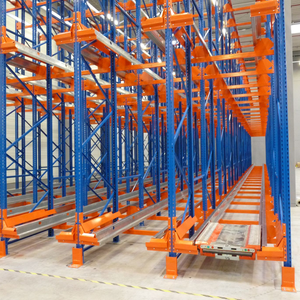
Customized Radio Shuttle Pallet Racking Automated Semi-Automatic Storage Racking for Logistics Centers
Contact Us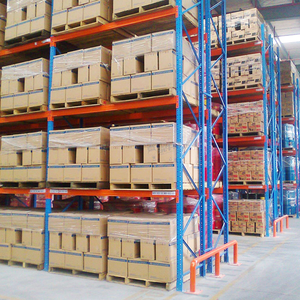
Combined Load-Row Connected Industrial Pallet Racking System Heavy Duty Warehouse Storage Racks 2000kg Steel
Contact Us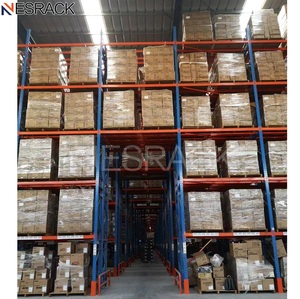
American Standard Hot Selling Heavy-Duty Metal Warehouse Storage Pallet Rack Steel Shelf Shelves Per Layer Hot Sell Storage
Contact Us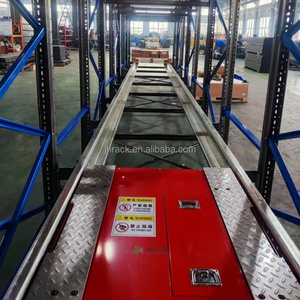
Automated Stackable Metal Shelves Storage Racks & Shelving Units Warehouse Asrs Pallet Shuttle Racking System
Contact Us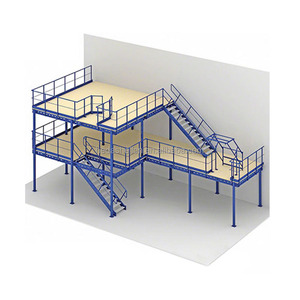
Warehouse Heavy Duty Steel Loft Platform Shelf Storage Attic Rack Pallet Racking Supported Mezzanine Floor Racks System
Contact Us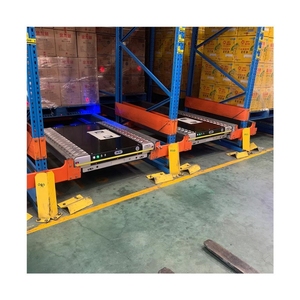
Blue Orange Customizable Colors Industrial Stacking Racks Heavy Duty Steel Pallet Rack System Warehouse Storage Shuttle Racking
Contact Us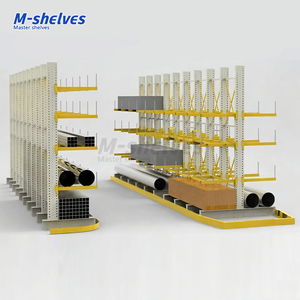
Heavy Duty Side Loading Steel Cantilever Racking System with Anti-Rust Finish for Warehouse Storage and Pipe Rack
Contact Us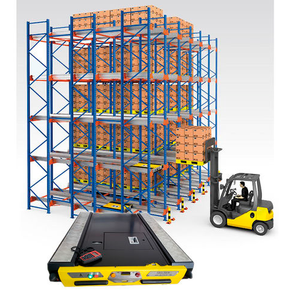
Adjustable Semi-automatic Warehouse Storage Rack Pallet Shuttle Racking System Radio Shuttle Storage System Stacking Shelves
Contact Us
Industry Whitepaper
Engineering Double Row Pallet Racking Systems for Modern Warehousing
An in-depth structural, mechanical, and logistical evaluation of back-to-back double-deep pallet storage frameworks.
Structural Mechanics of Double Row (Double-Deep) Configuration
Double Row Pallet Racking—frequently deployed as back-to-back single selective racks connected via structural row spacers or engineered deep-lane pantograph reach frameworks—represents the optimal balance between high volumetric floor-space utilization and operational stock selectivity. By placing two double-entry racking lines back-to-back, warehouse operators eliminate one operational aisle for every two rack banks, immediately increasing footprint efficiency by 30% to 55% over traditional single-selective layouts.
In structural engineering terms, a Double Row installation relies on rigidly bolted horizontal and diagonal frame bracing, coupled with heavy-duty back ties (row spacers) manufactured from structural steel profiles (such as 50x30mm rectangular tubing). These row spacers transform two isolated upright frames into a unified structural unit, dramatically increasing the second moment of area ($I_y$) and lateral torsional buckling resistance under severe gravity and dynamic forklift impact loads.
Volumetric Density & Floor Ratio
Double-deep row configurations store pallets two-deep per aisle entry. Utilizing specialized pantograph reach trucks or deep-reach forklifts, storage capacity expands up to 60% floor space occupancy. This drastically lowers cost-per-pallet-stored ($/pallet position) in expensive cold storage facilities and high-value urban logistics hubs.
High-Tensile Metallurgy (Q355B Steel)
Our heavy-duty upright columns utilize premier cold-rolled structural steel (Q355B / Equivalent to European S355JR) supplied directly by Chinese steel giants Baosteel and Masteel. With a guaranteed yield strength $\sigma_y \ge 355 \text{ MPa}$, our frames resist severe deformation under extreme static beam loads exceeding 4,000 kg per level.
Seismic Integrity & Global Standards
Engineered strictly to international standard mandates: FEM 10.2.02 (European Racking Code), RMI MH16.1 (USA standard), and AS4084-2012 (Australian Standard). Each system features heavy baseplates anchored with M12–M16 structural expansion anchors, engineered to withstand Zone 7 to Zone 9 seismic accelerations.
Key Technical Insight: The Mechanics of Beam Deflection & Safety Pins
In high-capacity double row pallet racks, structural deflection under full load is limited to a strict ratio of maximum $L/300$ (where $L$ is beam span length). Every connector claw is engaged with a high-shear structural drop-in safety pin capable of withstanding upward dislodgement forces $>15 \, \text{kN}$, completely eliminating forklift-induced accidental beam unhooking during high-bay retrieval operations.
Comparative Matrix
Selecting the Right Industrial Racking Architecture
Quantitative decision matrix for warehouse managers, supply chain directors, and structural procurement teams.
| Racking System Type | Storage Density | Direct Selectivity | Handling Equipment Cost | LIFO / FIFO Operational Flow | Ideal Application Industry |
|---|---|---|---|---|---|
| Double Row (Double-Deep) Pallet Racking | High (approx. 60%) | 50% Immediate Access | Medium (Deep-Reach / Pantograph) | LIFO (Last-In, First-Out) | FMCG, Cold Storage, Dry Foods, Paper & Packaging |
| Standard Selective Pallet Racking | Moderate (approx. 40%) | 100% Immediate Access | Low (Standard Counterbalance) | FIFO / LIFO Flexible | 3PL Warehousing, E-Commerce, High SKU Distribution |
| Radio Shuttle Automated Racking | Ultra-High (up to 85%) | Low (Per Lane Indexing) | High (Automated Shuttle Vehicles) | FIFO & LIFO Dual Mode | Beverage, Deep Freeze Logistics, Pharmaceuticals |
| VNA (Very Narrow Aisle) Racking | Very High (approx. 70%) | 100% Immediate Access | High (Specialized VNA Turret Truck) | FIFO / LIFO Flexible | High-Bay Distribution Centers, Automotive Spare Parts |
| AS/RS Automated High-Bay System | Maximum (up to 90%) | 100% Computer Controlled | Very High (Stacker Cranes / WMS) | Fully Automated Dynamic Flow | Smart Factories, New Energy Lithium Battery, Aerospace |
Enterprise Superiority
ApexDrive Industrial Racking Manufacturing Process
Controlled from raw steel coil to export container: inside our 20,000 sqm smart production base in Nanjing, China.
10-Stage Surface Treatment & Powder Line
Our 220-meter automated powder coating line incorporates Swiss Gema electrostatic spray guns. Racking steel undergoes full degreasing, acid rust removal, zinc-phosphate conversion coating, and high-temperature thermal curing at 180°C. Output achieves an anti-corrosion film thickness of 80–120μm, resisting 500-hour salt-spray tests.
German Continuous Roll-Forming Precision
Upright columns up to 12 meters are roll-formed in a single piece without intermediate splice welds. Multi-station roll tooling guarantees a cumulative hole-pitch tolerance within $\pm 2 \, \text{mm}$ over a full 12-meter profile height, ensuring perfect beam connector fitment and unyielding vertical geometry.
Robotic Laser & Manipulator Welding
Structural beam connector plates and baseplates are welded using Japanese robotic welding manipulators under protective gas atmospheres ($\text{CO}_2 / \text{Argon}$ mix). This eliminates human error, porosity, micro-cracks, and incomplete weld penetration across all load-bearing beam profiles.
Pre-Shipment Trial Assembly & Export Packing
Before containerized shipping, sample sets undergo complete 100% trial assembly to verify tolerance alignment. Uprights and beams are bundled with multi-layer steel strapping and protective edge profiles, while small hardware items are vacuum-sealed in heavy cartons on ISPM-15 compliant plywood pallets.
Industry Outlook
Future Procurement & Technological Trends in Industrial Racking
How automation, smart logistics sensors, and decarbonized steel are reshaping global warehouse infrastructure purchasing.
1. Transition Toward AMR & Vision-Guided Forklift Compatibility
Global warehouse procurement is rapidly shifting from manually operated reach trucks to Autonomous Mobile Robots (AMRs), Automated Guided Vehicles (AGVs), and Vision-Guided Forklifts. This revolution demands significantly tighter manufacturing tolerances on Double Row and Selective Pallet Racks. Floor levelness, beam deflection profiles, and aisle guiding rails must conform to ultra-precise DIN 15185 standards. Modern racking systems are engineered with integrated barcode indexing arrays and reflectors to support optical positioning sensors on robotic mast lifts.
2. IoT Telemetry & Structural Health Sensors
Next-generation double row storage structures are adopting strain-gauge sensor pods and dynamic inclination monitors. Integrated into critical upright bases, these IoT nodes stream real-time structural stress data, detecting accidental forklift collisions, overload warnings, and floor settlement before catastrophic collapse events occur.
3. Ultra-Low Temperature Cold Chain Optimization
With booming global trade in biologics, frozen foods, and vaccines, racking procurement for sub-zero (-30°C to -50°C) environments requires advanced metallurgical formulations. Hot-dip galvanizing (HDG per ISO 1461) and specialized low-temperature impact-resistant steel alloys prevent hydrogen embrittlement and coating flaking in cold chain infrastructure.
4. Decarbonization & Green Steel Procurement
Leading multinational enterprises prioritize suppliers with verified Environmental Product Declarations (EPDs). By sourcing raw structural steel produced via Electric Arc Furnaces (EAF) powered by renewable energy, Chinese export manufacturers offer lowered embodied carbon metrics without compromising structural yield capacity.
Purchasing FAQ
Frequently Asked Questions by International Buyers
Detailed technical, engineering, and commercial answers for structural project engineers and procurement managers.
What technical building and load parameters are needed for a custom layout design?
To produce an accurate CAD structural layout and formal quotation, our engineering team requires: (1) Warehouse building DWG CAD drawings or dimensioned architectural sketches showing total interior clear height, column matrix locations, floor slab load capacity ($\text{kN/m}^2$), door clearance, and fire sprinkler/pipe drops. (2) Pallet unit load specifics including width, depth, height (including timber pallet), and gross weight per pallet. (3) Operating environment temperature range (dry ambient, cold room, or freezer). (4) Forklift truck specifications—specifically maximum reach height, collapsed mast height, and minimum right-angle aisle turning radius.
What steel grades and mill certificates does ApexDrive provide?
We strictly utilize prime structural cold-rolled coil steel Q235B (yield point $\ge 235 \text{ MPa}$) and Q355B (yield point $\ge 355 \text{ MPa}$, equivalent to European S355JR / ASTM A572 Grade 50) directly procured from tier-1 mills such as Baosteel, Masteel, and Shougang. Every order includes original EN 10204 3.1 Mill Test Certificates (MTC) verifying chemical heat analysis, tensile strength, yield stress, and percentage elongation.
How does a Double Row system handle FIFO vs. LIFO stock management?
Double Row (Double-Deep) racking naturally operates under a LIFO (Last-In, First-Out) inventory rotation logic per pallet slot pair because access to the rear pallet requires removing the front pallet. To optimize operations, warehouse management systems (WMS) assign identical SKUs or batch lots to paired front-and-back slots. If 100% strict FIFO is required alongside high density, we recommend upgrading to our automated Radio Shuttle Pallet System.
What surface finish options are available for humid or corrosive cold storage?
For standard dry ambient warehouses, our 220-meter automated electrostatic powder coating system delivers a durable epoxy-polyester coating. For high-humidity environments, coastal regions, or deep-freeze cold storage facilities subject to heavy condensation, we recommend Hot-Dip Galvanizing (HDG) per ISO 1461. Under HDG, structural components are fully submerged in molten zinc at 450°C, forming a 65–85μm thick metallurgical zinc-iron alloy barrier that provides decades of anti-corrosion protection.
How are racking projects packaged and protected for transoceanic shipping?
Upright frames and horizontal beams are organized into heavy structural bundles bound with high-tensile PET and steel banding, wrapped in protective bubble film, and supported by heavy timber or steel dunnage feet to allow seamless forklift unloading at container destinations. Small components—such as beam safety locks, row spacers, baseplates, and expansion anchor bolts—are packed into heavy-duty corrugated cartons anchored to heat-treated plywood pallets (fumigation-free).
Do you supply overseas installation support and structural engineering stamped drawings?
Yes. Every project is accompanied by a detailed English installation booklet, complete structural assembly drawings, 3D exploded component diagrams, and step-by-step video installation guides. For major logistics hubs, our structural engineers can provide real-time remote video supervision or dispatch certified site installation supervisors directly to your facility overseas.
What safety factors are designed into ApexDrive pallet beam and column calculations?
Our structural design calculations strictly follow FEM 10.2.02 and RMI standards. Upright column buckling design incorporates a safety factor of $\ge 1.65$ to $1.8$ against ultimate structural failure. Beam deflection under safe working load (SWL) is strictly limited to $L/300$, ensuring structural rigidity and zero permanent set deformation under maximum rated pallet capacities.