Technical Whitepaper: Engineering & Architecture of Semi-Automated Pallet Racking
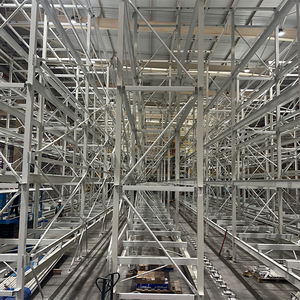
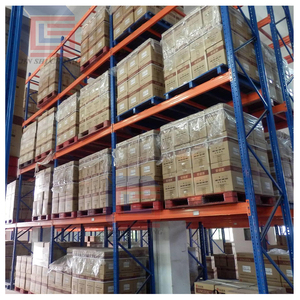
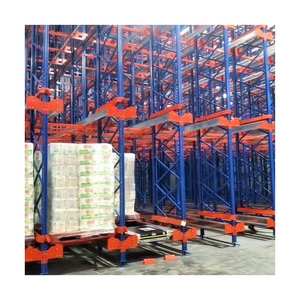
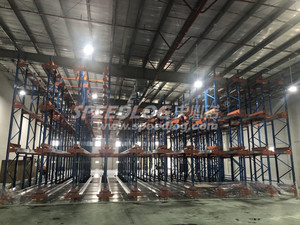
In modern industrial logistics, balancing operational throughput with volumetric floor space efficiency is a paramount challenge for supply chain managers, warehouse directors, and procurement specialists. As direct B2B exporters of industrial storage solutions from China, we engineer Semi-Automated Pallet Racking Systems—predominantly powered by Radio Shuttle (Pallet Runner) technology—to solve the structural limits of traditional drive-in racking while bridging the capital outlay gap of fully automated storage and retrieval systems (AS/RS).
1. Structural Mechanics and Material Integrity
The foundation of high-density semi-automated racking lies in structural steel physics. Unlike standardized selective pallet racks, radio shuttle channels carry dynamic loads imposed by both pallet weights (typically ranging from 500 kg to 1500 kg per position) and the acceleration/deceleration forces generated by autonomous electric shuttle carts.
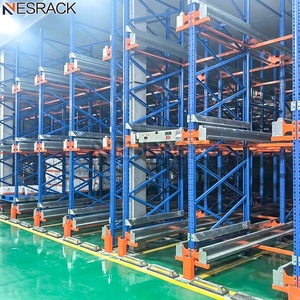
- Structural Steel Selection: We exclusively utilize prime cold-rolled Q235B and high-yield-strength Q355B structural steel supplied directly by China’s tier-1 steel mills (Baosteel, Masteel, and Wuhan Iron & Steel). Q355B steel provides a minimum yield strength of 355 MPa, allowing for higher column load capacity while keeping dead weight minimal.
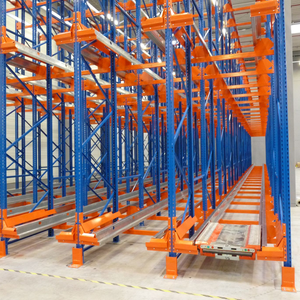
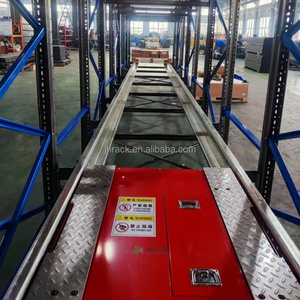
- Precision Guide Rail Design: The dedicated shuttle runner rails double as structural tie beams and running tracks. Roll-formed on dedicated 22-pass automated rolling mills, our guide rails achieve a cumulative pitch error under ±2 mm across a 12-meter continuous span, eliminating shuttle vibration, wheel wear, and derailment risks.
- Seismic & Load Tolerances: Designed strictly in compliance with FEM 10.2.02 (European Federation of Materials Handling) and RMI (Rack Manufacturers Institute) standards, our racking frames feature an upright safety factor of 1.8 and a maximum beam deflection rating of L/300 under full load.
2. System Comparison: Storage Density, Throughput & Capital Investment Matrix
Selecting the optimal warehousing architecture requires evaluating trade-offs between inventory accessibility, floor space footprint, operating labor, and total cost of ownership (TCO). Below is a engineering evaluation matrix comparing semi-automated radio shuttle systems against conventional racking methodologies:
| Racking Architecture | Volumetric Space Utilization | Direct SKU Accessibility | Operational Flow | Forklift Risk Level | CAPEX Index |
|---|---|---|---|---|---|
| Selective Pallet Racking | 35% – 45% | 100% Direct | FIFO / LIFO | Moderate | Baseline ($) |
| Drive-In Racking | 60% – 70% | Low (Per Lane) | Strictly LIFO | High (Forklift Enters Rack) | Low-Med ($$) |
| Semi-Automated Radio Shuttle | 75% – 85% | Moderate (Per Lane) | FIFO & LIFO Convertible | Minimal (No Entry) | Medium ($$$) |
| Automated AS/RS (Stacker Crane) | 85% – 95% | 100% Automated | FIFO / LIFO Dynamic | Zero (Fully Autonomous) | Very High ($$$$$) |
3. Operational Workflow of Semi-Automated Pallet Runner Systems
Semi-automated racking decouples forklift movement from lane retrieval. The operating sequence follows a streamlined three-phase procedure:
- Shuttle Placement: A standard forklift driver places the radio shuttle vehicle into the designated rail channel at any level.
- Pallet Loading & Deep Transport: The forklift deposits a pallet onto the front of the guide rails. Using wireless RF remote control or tablet WCS commands, the operator signals the shuttle. Optical photoelectric sensors detect the pallet, lift it via a high-torque pneumatic/hydraulic mechanism, and transport it rapidly inside the deep channel (operating speeds up to 1.1 m/s unloaded, 0.8 m/s loaded).
- Autonomous Positioning: The shuttle deposits the pallet at the closest available storage slot, maintaining precise 50 mm clearance gaps to maximize lane density, then returns to the front of the lane for the next unit load.