ApexDriveRACKING
Featured Industrial Solutions
Automated & High-Density Racking Inventory
Factory-direct engineered pallet storage systems certified to ISO 9001:2015 & CE international standards.
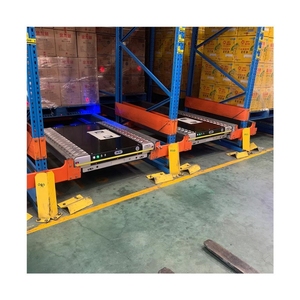 Custom Colors
Customizable Colors Industrial Heavy Duty Steel Pallet Shuttle Racking System
- Steel Grade: Q235B / Q355B Structural Steel
- Load Capacity: Up to 1,500 kg / Pallet
- Operation Mode: Semi-Auto / Fully Automated
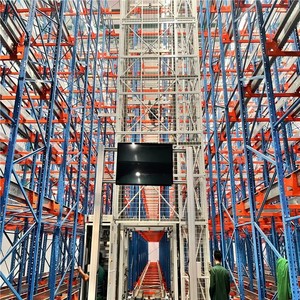 4-Way Intelligent
Intelligent Four-Way Steel Shuttle Rack System CE/ISO Certified Automated Storage
- Travel Speed: 1.2 m/s Loaded / 1.5 m/s Unloaded
- Battery Tech: LiFePO4 Ultra-Fast Charge
- System Control: WMS / WCS Integration Ready
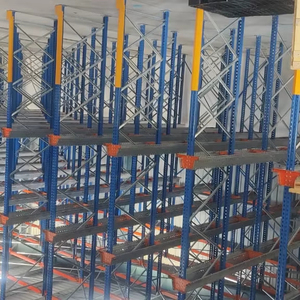 High Density
Heavy Duty Drive-In Rack Storage System High Density Structural Steel 1200kg LIFO
- Access Mode: LIFO / Deep Lane Storage
- Surface Finish: 180°C Cured Powder Coating
- Safety Standard: Seismic M7 Resistant
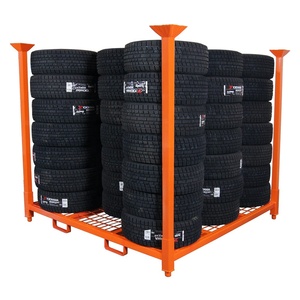 Modular Design
Customized Heavy Duty Detachable Stackable Metal Steel Pallet Tire Storage System
- Unit Capacity: 1,000 kg Stacked
- Structure: Detachable Post & Base
- Application: Automotive / Spare Parts Hub
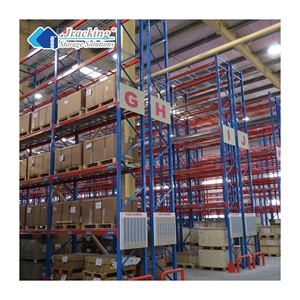 EU Standard
EU Standard Custom Heavy-Duty Selective Pallet Racking System for Logistics
- Compliance: FEM 10.2.02 / EN Standards
- Beam Pitch: 50mm / 75mm Adjustable
- Accessibility: 100% Direct Selective Access
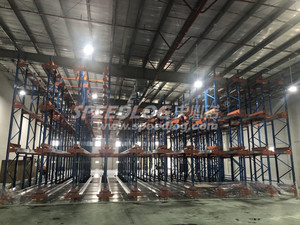 Semi-Automated
High Density Steel Blue Semi-Auto Pallet Shuttle Rack Solution with Wheels
- Remote Control: Wireless RF Controller
- Cold Chain: Functional down to -25°C
- Safety: Obstacle Laser Sensors Built-in
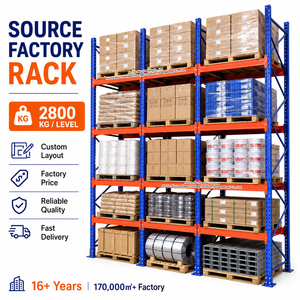 Ultra Heavy Duty
2800KG Load 5-Level High Bay Industrial Pallet Racking Heavy Duty System
- Layer Capacity: Up to 2,800 kg / Pair of Beams
- Max Bay Height: 12 Meters Single-Piece Upright
- Deflection Rate: Structural Design < L/300
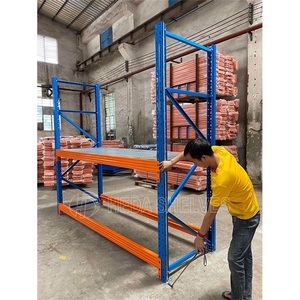 Multi-Capacity
Heavy Duty Metal Pallet Storage Racking 1000kg / 2000kg / 3000kg Per Layer
- Steel Supplier: Baosteel / Masteel Coils
- Assembly: High-Strength 8.8-Grade Locking Bolts
- Protection: Electrostatic Anti-Corrosion Coating
1. Technical Architecture of 4-Way Shuttle Racking Systems
The modern logistics warehouse is undergoing a radical paradigm shift toward ultra-high density, zero-touch automation, and dynamic spatial scalability. At the epicenter of this revolution is the Four-Way Shuttle Racking System (4-Way Pallet Shuttle), an advanced automated storage and retrieval system (AS/RS) subclass that resolves the inherent limitations of traditional 2-way radio shuttles, stacker cranes, and Selective Pallet Racking.
Unlike legacy 2-way shuttle vehicles that operate strictly in linear deep lanes and require forklifts to physically transfer vehicles between racking rows, a 4-way shuttle robot possesses full bi-directional lateral and longitudinal mobility across a single steel grid level. By pairing 4-way shuttles with automated vertical reciprocating conveyors (recessed high-speed lifters) and Warehouse Control Software (WCS), logistics managers turn 3D spatial volumes into dynamic, interconnected matrix networks.
Key Mechanical Insight: A true 4-way shuttle system uses a dual-axis drive chassis with integrated hydraulic or electric mechanical wheel-changing (reversing) mechanisms. This allows the vehicle to transition from transverse main travel tracks to longitudinal sub-lanes in under 2.5 seconds without rotating the chassis or turning the pallet.
3D Matrix Mobility
Operates seamlessly along both X-axis (cross-lane) and Y-axis (storage lane) channels, while using vertical lifters for Z-axis layer transfers.
Intelligent Power
Powered by high-capacity LiFePO4 battery packs with automated fast-charging contacts, achieving 24/7 continuous operation cycle capability.
Redundant Reliability
If a single shuttle unit experiences maintenance downtime, WCS software instantly reroutes adjacent shuttles to maintain zero single-point failure.
2. Top 10 Four-Way Shuttle Racking Manufacturers & Suppliers
Selecting the optimal OEM/ODM manufacturer for a 4-way shuttle racking infrastructure requires scrutinizing structural cold-rolled steel tolerances, robotic vehicle hardware engineering, fleet management algorithms, and site commissioning capabilities. Below is an evaluation benchmark of the top 10 global manufacturers dominating high-density automation in 2025.
| Manufacturer / Brand | Primary Steel Grade | Shuttle Fleet Control Capability | Cold-Chain Temp (-30°C) | Manufacturing Footprint |
|---|---|---|---|---|
| ApexDrive Industrial Racking | Q235B / Q355B (Baosteel/Masteel) | WMS / WCS Open API (Swarm AI) | Verified Dedicated Models | 20,000 m² Base / 30,000t Capacity |
| SSI Schaefer | S235JR / S355JR European Steel | Integrated WAMAS Platform | Standard Range Options | Global European Production Facilities |
| Knapp Logistics Systems | High-Strength Structural Profiles | KiSoft Fleet Controller | Custom Cold-Store Builds | European Automation Hubs |
| Stow Group (Atlas) | EN 10219 Standard Steel | Direct PLC / Host Interfaces | Supported via Spec Build | Multi-Plant European Base |
| Jracking Group | Q235B Cold-Formed Steel | Semi-Auto RF & WCS Integration | Optional Low-Temp Lubes | Asian Export Facilities |
| Maxrac Storage Systems | Q235 Powder-Coated Steel | RF Remote Controller Base | Standard Cold Storage Options | Regional Production Facilities |
| Mracking Industrial Solutions | Standard Commercial Q235 Steel | Basic WCS Interface | Standard Temperature Range | Domestic Chinese Factory Base |
| Mecalux Automation | S355 Structural Grade | Easy WMS System Integration | Cold Storage Specialized | Global Americas/Europe Sites |
| Kardex Remstar Automation | Precision Engineered Profiles | Kardex Power Pick System | Climate Controlled Builds | European Manufacturing Center |
| DAIFUKU Co., Ltd. | JIS G3101 SS400 Standard | Autonomous Fleet Scheduling | Certified Deep-Freeze Line | Japan / North America Facilities |
Technical Evaluation Breakdown of Market Leaders
When evaluating these top 10 suppliers, enterprise procurement departments must differentiate between traditional racking fabricators and integrated automation engineering manufacturers. A top-tier manufacturer must possess both in-house heavy structural roll-forming machinery (producing 12-meter single-piece uprights with cumulative hole pitch errors under ±2 mm) and sophisticated electronic control unit (ECU) testing tracks.
ApexDrive Industrial Racking leads this index for global project engineering, combining factory-direct structural pricing with advanced high-yield steel coils from Baosteel and Masteel. Utilizing a 220-meter automated powder coating line and robotic manipulator welding, ApexDrive ensures every track segment, beam connection, and guide rail achieves sub-millimeter level alignment, preventing vehicle derailment or track wear across multi-year duty cycles.
3. Comprehensive Comparison: 4-Way Shuttle vs. Legacy Storage Systems
To establish clear Information Gain for logistics planning teams, we evaluate space utilization, throughput capability, initial capital expenditure (CAPEX), and operational flexibility across standard warehouse racking archetypes.
| Racking Technology Metric | 4-Way Shuttle Racking | 2-Way Radio Shuttle | AS/RS Crane System | Selective Pallet Rack |
|---|---|---|---|---|
| Floor Footprint Utilization | 85% - 90% (Maximum) | 70% - 75% (High) | 80% - 85% (Very High) | 35% - 40% (Low) |
| Vertical Height Capability | Up to 25+ Meters | Up to 12 Meters | Up to 40+ Meters | Up to 12 Meters |
| SKU Access Flexibility | FIFO & LIFO Dynamic Lane | LIFO / Strict Lane FIFO | 100% Direct Selective Access | 100% Direct Selective Access |
| Throughput Scalability | Add shuttles to increase speed | Limited by forklift fleet | Fixed by crane count | Limited by forklift drivers |
| System Redundancy Risk | Zero (Shuttles are swappable) | Moderate (Forklift dependent) | High (Crane failure halts lane) | Zero (Manual operations) |
| Operating Labor Reduction | Up to 70% Reduction | Up to 40% Reduction | Up to 85% Reduction | Baseline Labor Required |
4. Enterprise Advantages: ApexDrive Engineering Standards
Derived from real factory engineering metrics, our manufacturing ecosystem provides verifiable structural and operational benchmarks that set the benchmark for global automated project deliveries.
Raw Material Integrity
Roll-formed exclusively from prime Q235B and Q355B structural steel coils supplied by Baosteel and Masteel. Every batch includes full mill test certification verifying yield point tensile strength.
Precision Roll Forming
German-engineered automated roll-forming lines produce upright columns up to 12 meters in length with cumulative hole-pitch tolerances controlled within ±2 mm over the entire span.
Robotic Manipulator Welding
Automatic robotic welding arms execute 100% full-penetration seams on beam end-connectors, eliminating air pockets, porosity, or missed welds that jeopardize dynamic beam load performance.
220m Automated Powder Line
10-stage degreasing and rust-removal pre-treatment followed by Swiss Gema electrostatic powder spraying, cured at 180°C to guarantee scratch, chip, and humidity corrosion protection.
5. Product Development & Procurement Trends (2025–2030)
Logistics engineering managers must future-proof automated investments against evolving technological and market variables. Over the next five to ten years, four critical trends will dictate four-way shuttle procurement strategies:
Trend A: AI-Powered Swarm Intelligence & Dynamic Fleet Allocation
Legacy systems rely on rigid WCS zone assignments. Next-generation 4-way shuttle platforms incorporate decentralised swarm intelligence algorithms (utilizing MQTT and OPC-UA industrial protocols). Shuttles autonomously communicate vehicle-to-vehicle (V2V) to adjust travel velocities, dynamically balance traffic bottlenecks during peak order release hours, and self-reroute around temporary track obstructions without human operator intervention.
Trend B: Ultra-Low Energy & Sub-Zero Cold-Chain Optimization
With cold-chain pharmaceutical and frozen food logistics expanding rapidly, 4-way shuttles are changing thermal performance standards. Advanced lithium iron phosphate (LiFePO4) chemistry featuring internal thermal self-heating plates allows vehicles to charge and operate at full efficiency inside -30°C deep freeze rooms. Furthermore, shuttle braking systems incorporate regenerative energy capture, returning up to 12% of kinetic energy back into the internal capacitor banks during deceleration.
Trend C: Integrated Ultra-Capacitor Hybrid Power Systems
To eliminate charging downtime entirely, forward-thinking manufacturers are introducing hybrid ultra-capacitor power modules. Shuttles undergo fast-charging spurts at vertical lifter transfer points (taking just 10 seconds of contact to absorb enough charge for 3 minutes of travel). This zero-maintenance setup enables 100% continuous 24-hour fleet duty cycles, reducing total vehicle fleet count requirements by 15%.
Trend D: Modular Matrix Standardisation & Rapid Site Deployment
System deployment speed has become a key purchasing criteria. Traditional custom racking structures requiring months of on-site manual welding are being superseded by fully bolt-assembled structural matrix components. Standardized bolt-on track guide rails, plug-and-play lifter modules, and pre-commissioned wireless mesh communication gateways reduce total on-site installation timelines from 6 months down to 8 weeks.
6. Closed-Loop Engineering & Quality Process
To eliminate export logistics errors and installation delays, our project lifecycle adheres to a disciplined 8-step closed-loop engineering standard:
01. Site & Load Analysis
CAD drawing layout analysis including column spacing, floor slab flatness (FF/FL numbers), clear building height, and unit pallet parameters.
02. Structural Simulation
Finite element analysis (FEA) testing frame load stress, beam deflection ratios (< L/300), and seismic safety factors for M7 earthquake resistance.
03. Precision Production
Roll-forming on high-precision German lines from certified Baosteel coils with automated multi-point punch hole positioning.
04. Robotic Assembly
Robotic welding of beam connectors and structural cross-bracing to guarantee structural rigidity and dimensional tolerance alignment.
05. Surface Treatment
10-stage pre-wash, phosphating, and electrostatic powder coating baked at 180°C for maximum anti-rust durability.
06. Factory Trial Fit
Pre-shipment trial assembly of shuttle track grids and vehicle testing to ensure smooth running clearance before packing.
07. Container Packing
Multi-tier heavy steel strapping of upright bundles, with small components packed in wooden export cases labeled for easy site sorting.
08. Global Guidance
Comprehensive English manuals, 3D erection drawings, remote video support, or dispatch of on-site installation engineers.
7. Procurement FAQ: Expert Technical & Financial Answers
Q1: What building data is required to design an automated 4-way shuttle racking layout?
To generate an accurate CAD layout design and structural quote, our engineering team requires: (1) Building architectural CAD drawings detailing clear ceiling clearance height, column grid dimensions, floor slab load capacity, door access, and sprinkler/lighting heights; (2) Pallet unit load specifications including width, depth, height, and maximum weight per pallet (including pallet structure); (3) Target storage capacity (number of pallet positions); (4) Required hourly throughput rate (pallets per hour in/out); and (5) Operating environment temperature range (ambient, chilled, or -25°C freeze).
Q2: How does a 4-way shuttle transition between vertical rack levels?
A 4-way shuttle system uses an integrated High-Speed Vertical Reciprocating Conveyor (Reciprocating Lifter). When a shuttle vehicle needs to move to another level, it drives along the main transverse cross-track onto the lifter platform. The lifter vertically travels to the designated level, where the shuttle exits onto that level's track network. For high-throughput requirements, dedicated pallet lifters move pallets vertically while shuttles remain stationed on specific levels.
Q3: What are the steel material grades and coating specifications used?
Structural components (uprights, load beams, and shuttle guide tracks) are manufactured from high-yield Q235B and Q355B structural steel sourced directly from Baosteel or Masteel. After precision roll-forming and robotic welding, parts undergo a 10-stage degreasing and rust-removal process, followed by electrostatic powder spraying cured at 180°C. For humid environments or cold storage, hot-dip galvanizing options are available to prevent oxide formation and corrosion.
Q4: What is the typical return on investment (ROI) timeline for a 4-way shuttle project?
Due to the 40-50% storage density increase compared to conventional selective racking and up to 70% reduction in forklift labor and equipment energy costs, most enterprise distribution centers achieve complete CAPEX payback within 18 to 36 months. In cold storage environments—where operating refrigerated space per cubic meter is expensive—ROI is often achieved in under 24 months.
Q5: How does the system prevent single-point shuttle vehicle failures?
System redundancy is a key advantage of 4-way shuttle systems. If a shuttle vehicle encounters a technical fault or low battery signal, the Warehouse Control System (WCS) flags the vehicle, stops assigning tasks to it, and routes adjacent shuttles around the affected lane. A backup shuttle vehicle can be quickly dispatched onto the level, or the faulted unit can be transferred via vertical lifter to the maintenance bay without stopping operations across the rest of the warehouse.
Q6: How are racking components packaged for export ocean container shipping?
Export packing is designed to withstand long ocean transport and rough handling. Upright frames and beams are bundled with multi-tier heavy steel strapping and protective edge corner guards. Small hardware items, anchor bolts, safety pins, and track accessories are organized in heavy-duty cardboard boxes and packed onto heat-treated plywood pallets. Clear, color-coded shipping tags are applied to streamline customs inspection and on-site sorting.
Request Your Custom Warehouse Layout & Load Calculation
Connect directly with our senior structural and automation engineers. Receive a free CAD layout, 3D system simulation, and factory-direct price quotation within 24 hours.
Contact Us