Technical Guide to Chemical Industry Storage Racking Architecture
Comprehensive technical analysis on structural safety, corrosion mitigation, seismic compliance, and intent-driven procurement for chemical storage facilities worldwide.
In modern industrial logistics, Chemical Industry Storage Racking represents one of the most demanding engineering domains within material handling. Warehouses storing raw chemical agents, agrochemicals, polymers, liquid resins, specialty solvents, and hazardous substances must operate under rigorous regulatory constraints. Unlike standard FMCG or ambient retail warehouses, a chemical storage warehouse faces continuous threats from corrosive vapors, chemical leaks, heavy localized point loads from 1000L IBC totes or 205L steel drums, and stringent environmental containment compliance mandates.
As a global leader in high-durability storage systems, ApexDrive Industrial Racking Co., Ltd. approaches Chemical Industry Storage Racking through an integrated engineering framework that prioritizes structural safety factor buffers, advanced metallurgy, surface chemistry, and automated logistics compatibility. This document outlines the fundamental technical considerations, system recommendations, procurement trends, and engineering standards necessary for managing risk and maximizing ROI in chemical warehousing.
Chemical storage racking systems must be calculated with elevated safety margins. ApexDrive Industrial Racking Co., Ltd. designs chemical upright frames and beams with a structural safety factor of 1.8 (exceeding standard 1.66 thresholds) and limits beam deflection strictly to L/300 to prevent dynamic instability during forklift placement of high-mass fluid containers.
1. Key Engineering Challenges in Chemical Storage Warehousing
Global procurement teams and chemical facility managers frequently inquire about structural survival in harsh chemical environments. Designing chemical racking requires addressing four key physical and chemical stress vectors:
Corrosive Atmosphere & Vapors: Volatile organic compounds (VOCs), acidic fumes (e.g., hydrochloric or sulfuric acid off-gassing), and alkaline vapors aggressively attack raw steel. Standard industrial paint degrades rapidly, exposing steel structural profiles to oxidation, structural thinning, and eventual load collapse.
Extreme Concentration of Point Loads: Liquid chemicals stored in Intermediate Bulk Containers (IBC totes weighing up to 1,200 kg each) or dense groups of 200-liter steel drums generate concentrated point loads rather than uniformly distributed loads (UDL). Racking beams must feature reinforced profile sections and drop-in support bars to prevent localized torque and web buckling.
Spill Containment and Drainage Integration: In chemical storage, spilled liquids must not collect on structural racking members or drop uncontrollably to lower tiers. Racking layout engineering must accommodate spill containment bunds, sumps, mesh decks, and overhead fire sprinkler clearance according to NFPA 30 and EN 15512 guidelines.
Seismic Resilience & Floor Anchor Stress: Chemical spills during a seismic event carry catastrophic environmental and financial risks. Racking upright bases must feature heavy-duty floor plates anchored with multi-bolt chemical anchor studs into high-MPa reinforced concrete slabs to survive seismic accelerations up to Seismic Zone Zone 4 (M7 intensity).
Targeted Racking Systems
Recommended Chemical Industry Storage Racking Solutions
ApexDrive Industrial Racking Co., Ltd. engineers custom-configured racking systems designed specifically to handle chemical drums, pallets, IBC totes, and raw material inputs.
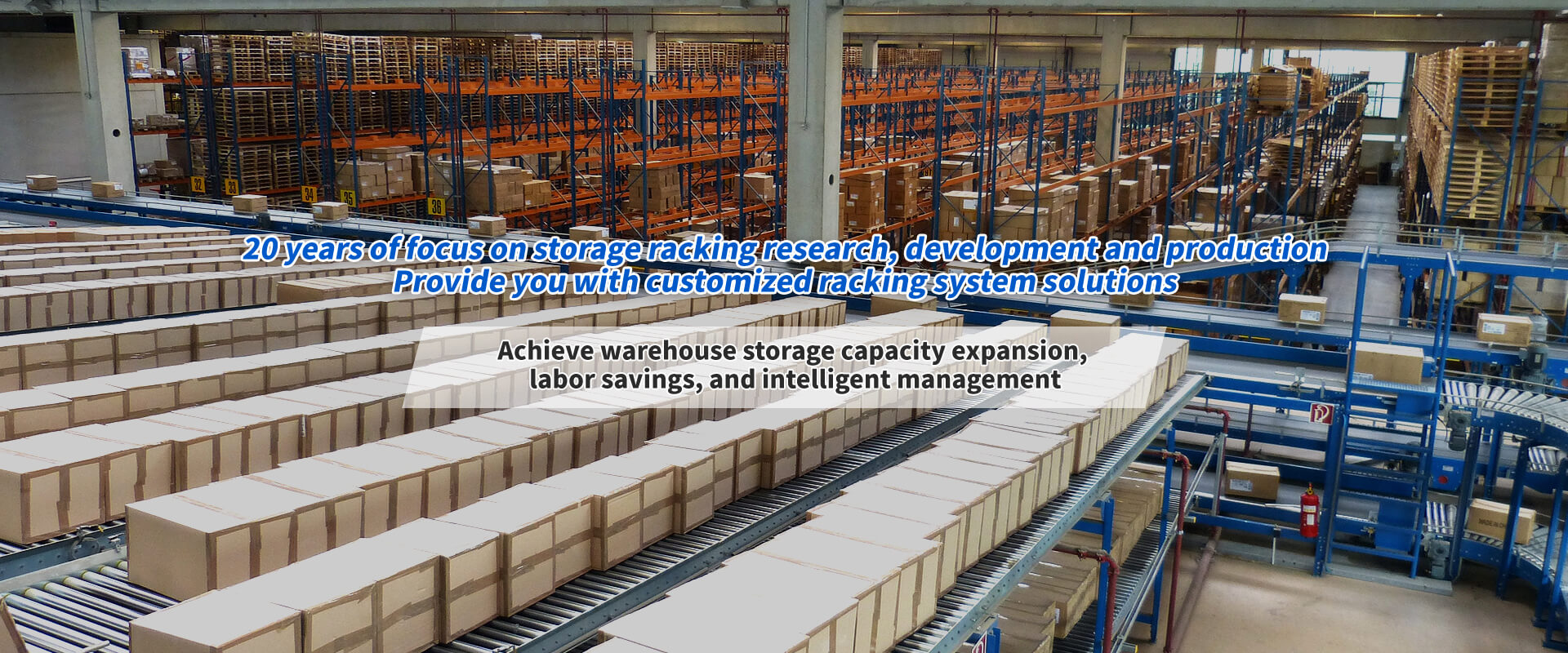
100% Direct Access
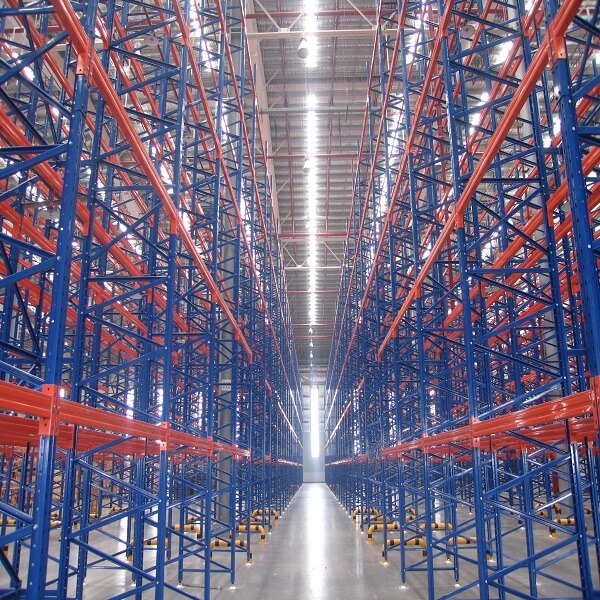
Selective Chemical Pallet Racking
Configured with heavy-duty profile uprights, reinforced drop-in drum cradles, mesh decking, and secondary spill tray supports. Designed for maximum SKU selectivity in chemical raw material vaults.
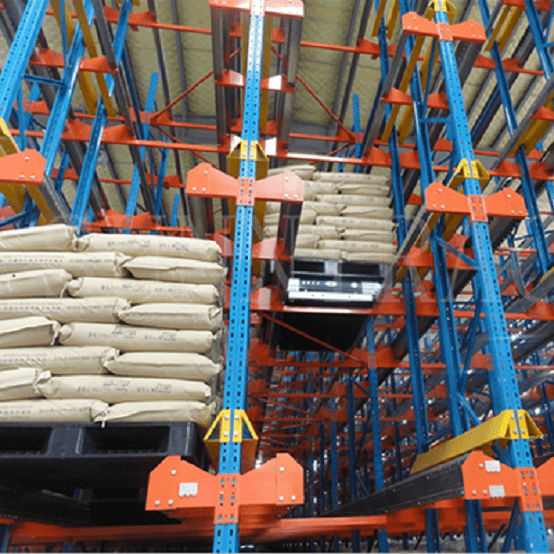
Deep-lane automated shuttle storage designed to eliminate forklift entry into hazardous chemical zones. Features remote-guided carts, anti-spark components, and high-density channel layouts.
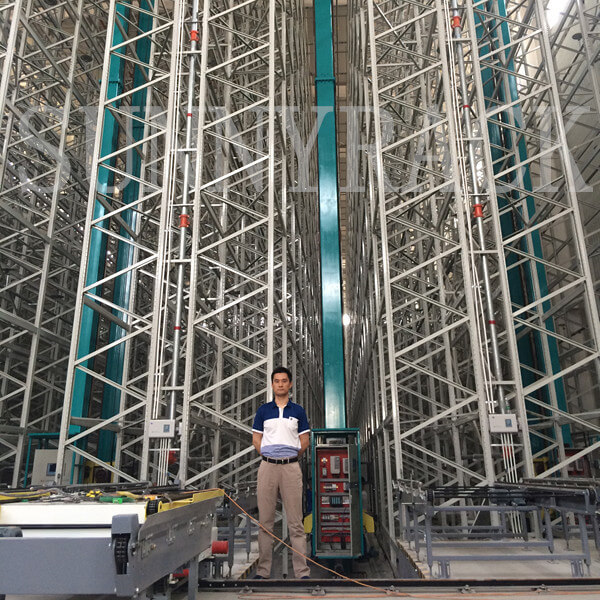
High-bay rack-supported automated storage and retrieval systems operating up to 35 meters in height. Integrated with climate control, explosion-proof sensor suites, and automated WMS integration.
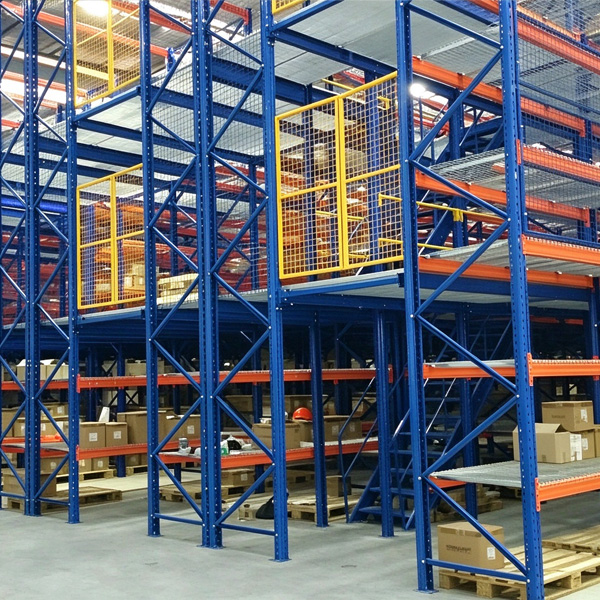
Rack-supported multi-level walkways designed for manual picking of small chemical reagents, additives, and laboratory supplies with anti-slip perforated steel floor panels.
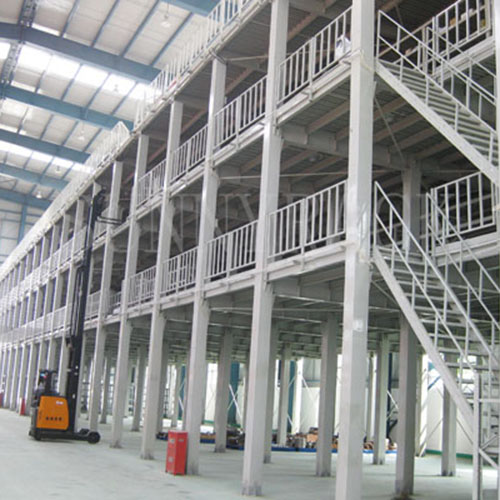
Heavy-gauge structural steel floors providing overhead space for chemical mixing tanks, dosing equipment, or administrative control rooms built above active storage floors.
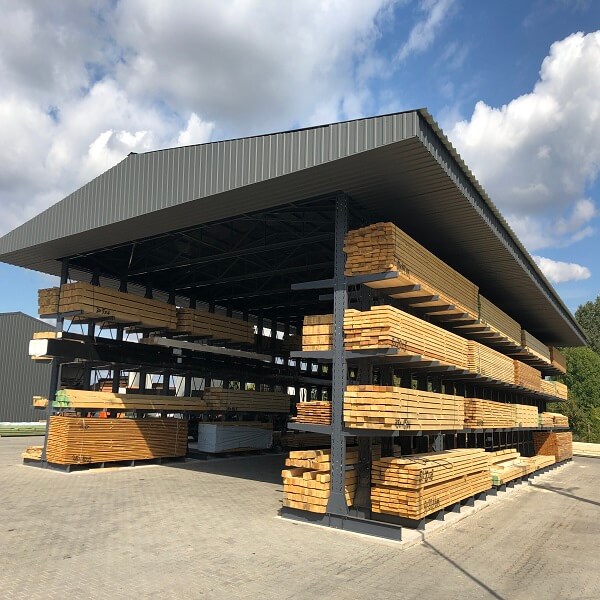
Unobstructed arm storage engineered for rigid PVC/HDPE piping, stainless steel chemical tubing, raw synthetic cylinders, and long corrosion-resistant raw materials.
ApexDrive Manufacturing Rigor for Chemical Racking
Every structural upright, load beam, and bracket undergoes strict metallurgical and chemical surface refinement inside our 20,000 m² automated production center.
01
Prime Raw Materials — Tier-1 Steel Mills
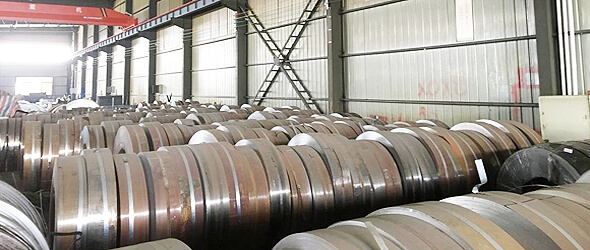
ApexDrive Industrial Racking Co., Ltd. procures prime structural Q235B and Q355B hot-rolled steel coils exclusively from premier Chinese steel conglomerates, including Baosteel, Masteel, and Wuhan Iron and Steel. Mill test certificates (MTC) accompany every batch, verifying yield strength, elongation, and chemical composition before cold roll-forming begins.
Baosteel / Masteel Coils
Traceable Heat Numbers
High Yield Strength
02
Precision Roll-Forming — Uprights Up to 12 Meters
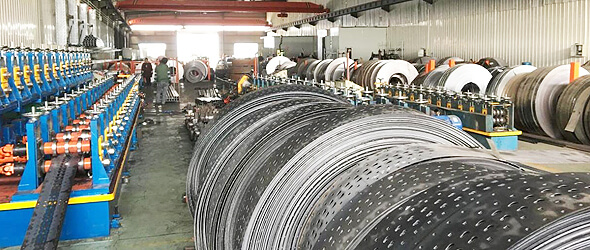
Our German-engineered continuous cold roll-forming production lines process multi-stage profile uprights up to 12 meters in a single continuous section. Pitch hole alignment accuracy is maintained within a tight cumulative tolerance of ±2 mm over 12 meters, ensuring seamless beam connector seating and uniform load transfer.
German Roll-Form Tech
Continuous 12m Uprights
±2 mm Tolerance
03
Robotic Welding — Continuous Structural Joints
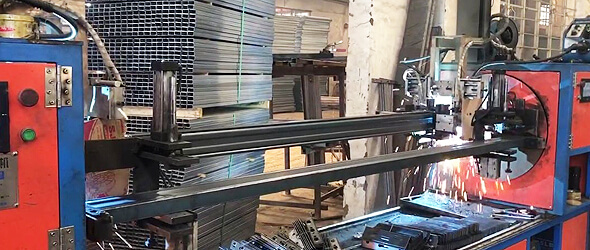
To eliminate manual welding human errors and joint micro-cracking, beam connector claws and structural column footplates are welded using multi-axis automatic robotic manipulators. Weld seams are full, continuous, and free of slag or gas porosity, ensuring high fatigue resistance under cyclic chemical loading.
Robotic Automation
Zero-Porosity Welds
EN ISO 3834 Compliant
04
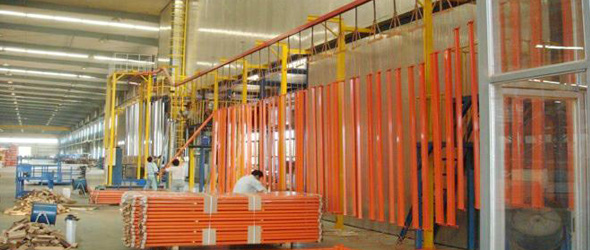
Corrosion Pre-Treatment — 220m Automatic Line & 180°C Curing
For Chemical Industry Storage Racking, surface finishing is the critical line of defense. Raw steel components undergo a 10-stage automated surface cleaning process (including acidic degreasing, zinc phosphating, and deionized water rinsing) followed by electrostatic thermosetting powder application via Swiss Gema automatic spray guns. Cured at 180°C in a 220-meter continuous oven, the resulting epoxy-polyester coating delivers exceptional resistance to chemical splashes, humidity, and mechanical abrasion.
Swiss Gema Spraying
10-Stage Phosphating
180°C High-Temp Curing
05
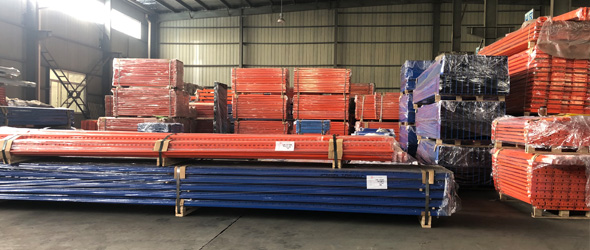
Heavy Packaging — Damage-Free Global Shipping
All finished chemical racking components are bundled using multi-tier heavy steel strapping, corner protectors, and moisture-proof plastic wrapping. Structural hardware, beam safety locks, and baseplates are packed in reinforced wooden crates and plywood pallets, simplifying customs clearance and preventing shipping damage during transoceanic transport.
Steel Strapping
Plywood Palletization
Customs Labeled Kits
Industry Insights & Market Intelligence
Future Procurement & Development Trends in Chemical Storage Racking
Key strategic shifts transforming global chemical supply chain logistics and hazardous material warehouse architecture through 2030.
As global environmental safety standards become more stringent and labor costs rise, chemical enterprise procurement officers are adapting their infrastructure strategies. Below are four key trends shaping the future of Chemical Industry Storage Racking:
Trend 1: Accelerated Adoption of Hazardous-Zone AS/RS Automation
Chemical logistics operators are rapidly replacing manual forklift storage in high-risk chemical storage vaults with automated stacker cranes and self-guided shuttles. Human presence inside hazardous material (hazmat) warehouses is minimized to mitigate exposure to toxic fumes and potential chemical reactivities. Modern chemical AS/RS units are outfitted with ATEX explosion-proof sensors, spark-resistant polyurethane wheels, and integrated fire isolation shutters that isolate specific aisles in the event of thermal runaways or chemical fires.
Trend 2: Integrated Chemical Spill Containment Decking & Modular Sumps
Rather than relying solely on floor-level concrete sumps, chemical storage racking is evolving toward level-integrated spill containment. Procurement specifications increasingly call for heavy-duty galvanized grating decks coupled with drop-in polyethylene or epoxy-coated steel catchment pans under every pallet level storing liquid chemicals. This modular containment strategy prevents a leak on Level 4 from cascading down and contaminating dozens of lower pallets, significantly reducing environmental clean-up costs.
Trend 3: Hybrid Coating Systems & Duplex Corrosion Protection
For chemical environments exposed to acidic vapors (such as chlorine, fertilizer salts, or battery electrolytes), standard single-layer powder coating is no longer sufficient. The industry is transitioning toward Duplex Corrosion Protection, which combines continuous hot-dip galvanizing (HDG) with an secondary electrostatic epoxy powder topcoat. This hybrid finish provides sacrificial zinc protection alongside a chemical-resistant polymer barrier, extending racking operational life from 5 years to over 20 years in highly aggressive atmospheres.
Trend 4: IoT-Enabled Structural Health Monitoring & Smart Racking Anchors
Leading chemical storage facilities are equipping heavy-duty upright columns with embedded IoT vibration, tilt, and strain sensors. Because chemical warehouses handle heavy, volatile liquid loads, unseen forklift impacts or floor settlement can lead to catastrophic progressive collapses. Smart racking sensors provide real-time structural health monitoring, alerting warehouse managers to column deflection or baseplate bolt loosening long before structural failure occurs.
Why Choose ApexDrive
Engineering Excellence in Chemical Storage Systems
ApexDrive Industrial Racking Co., Ltd. provides end-to-end expertise, from structural calculation to export-compliant manufacturing and global installation support.
Custom Engineering
Free structural layout design, FEM analysis, and chemical load calculations tailored to your exact warehouse layout.
Certified Manufacturing
20,000 m² factory equipped with 150+ sets of roll-forming machinery, robotic welding, and automated powder lines.
International Compliance
Strict adherence to ISO 9001:2015 quality standards and European CE structural certification criteria for safety.
Global Installation
Detailed English installation manuals, step-by-step assembly drawings, and remote/onsite engineering support.
Evaluate storage density, chemical compatibility, selectivity, and handling equipment requirements for your facility.
Comparison matrix based on standard chemical storage configurations. Final capacity varies with IBC tote dimensions, drum pallet profiles, and building roof clearances.
ApexDrive Industrial Racking Co., Ltd. — Your Trusted Storage Partner
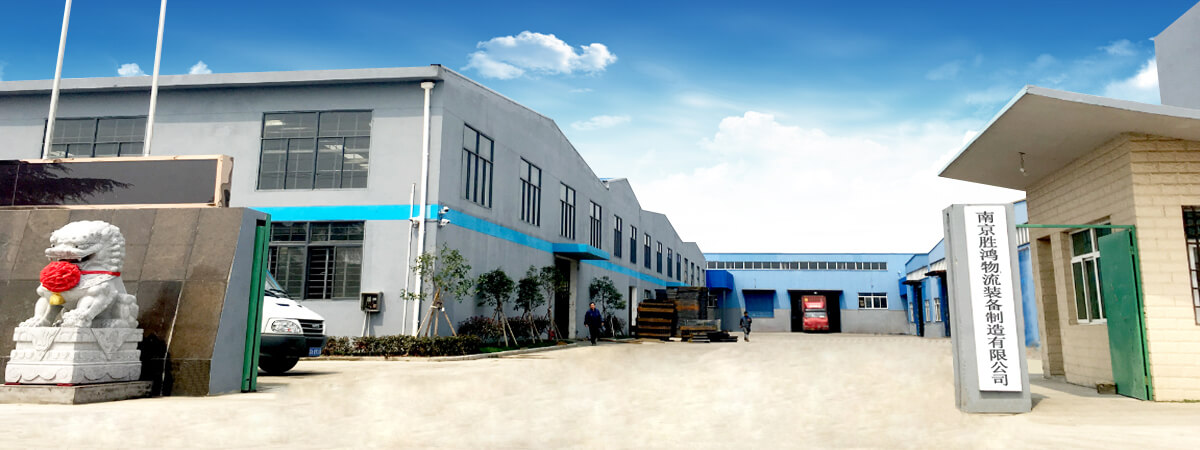
Established in September 2006, ApexDrive Industrial Racking Co., Ltd. is a specialized enterprise dedicated to the design, engineering, production, sales, and global installation of heavy-duty industrial storage systems. Operating from a modern 20,000 m² manufacturing plant equipped with over 150 sets of specialized cold-forming and robotic welding equipment, we achieve an annual steel rack production capacity exceeding 30,000 metric tons.
Our comprehensive portfolio covers selective pallet racking, radio shuttle systems, automated storage and retrieval systems (AS/RS), mezzanine floors, steel platforms, cantilever racks, drive-in racking, and non-standard custom racks tailored for chemical manufacturing, pharmaceuticals, automotive, cold-chain logistics, and retail logistics. We pride ourselves on rigorous ISO 9001:2015 quality control, CE safety compliance, and robust technical support.
Independent third-party verification ensuring full compliance with global structural and manufacturing standards.
Procurement FAQs
Frequently Asked Questions About Chemical Industry Storage Racking
Engineering and procurement guidance directly from our technical sales team for buyers evaluating chemical warehouse installations.
What finish is best for chemical racking: Powder Coating or Hot-Dip Galvanizing?
The optimal finish depends on the chemical environment. For dry chemical storage, organic solvents, or non-volatile powders, our 180°C cured electrostatic epoxy-polyester powder coating provides superior impact resistance and excellent chemical protection. However, for acid storage rooms, fertilizer warehouses, or outdoor chemical facilities exposed to aggressive chemical vapors, Hot-Dip Galvanizing (HDG) according to ISO 1461 is recommended to deliver self-healing sacrificial zinc protection against oxidation.
How do you ensure racking safety when storing heavy 1000L IBC totes or chemical drums?
Storing 1000L IBC totes (weighing ~1,200 kg each) requires custom beam profile engineering. We equip chemical pallet racking with heavy box beams, drop-in pallet support bars, or heavy-duty wire mesh decks. For steel drum storage, we integrate welded drum cradles or curved anti-roll chocks to lock cylindrical drums in place, preventing dynamic rolling or point-load web distortion on upright frames.
What information is needed to design a custom chemical warehouse layout?
To generate a precise CAD drawing and structural design, we require: (1) Warehouse building CAD drawing showing clear height, column grids, drain sumps, and fire door locations; (2) Chemical load details, including pallet/tote dimensions, weight per unit, and hazard classification; (3) Required total pallet capacity and SKU counts; (4) Preferred handling equipment (forklift lift height and aisle radius); (5) Environmental conditions such as ambient humidity, chemical fumes, or cold storage specs.
Can ApexDrive chemical racking accommodate secondary spill containment trays?
Yes. We regularly design chemical racking to integrate with secondary spill containment systems. Our beam levels can be spaced to accommodate removable steel or polyethylene bunded spill trays beneath pallets. Alternatively, we manufacture rack-integrated mesh decking engineered to allow spilled liquids to channel directly into floor-level containment sumps without compromising structural stability.
How are chemical racking components protected during ocean shipping?
All components manufactured by ApexDrive Industrial Racking Co., Ltd. are packaged specifically for overseas shipping. Uprights and beams are secured in steel-strapped bundles with protective plastic film and cardboard corner edge covers. Fasteners, baseplates, and delicate accessories are packed in heavy-duty corrugated cartons anchored onto heat-treated plywood pallets to prevent damage during customs handling and transit.
Does ApexDrive provide on-site installation support for overseas chemical racking projects?
Yes. We provide complete installation packages including detailed CAD assembly drawings, component erection schedules, and step-by-step English instruction manuals. Our technical team offers real-time video guidance throughout assembly. For large-scale chemical warehouse projects or automated AS/RS installations, ApexDrive can dispatch experienced installation engineers directly to your overseas facility.
Start Your Engineering Plan
Ready to Optimize Your Chemical Warehouse Safety & Density?
Connect with senior chemical storage engineers at ApexDrive Industrial Racking Co., Ltd. for a free consultation, layout plan, and factory-direct quote.
 100% Direct Access